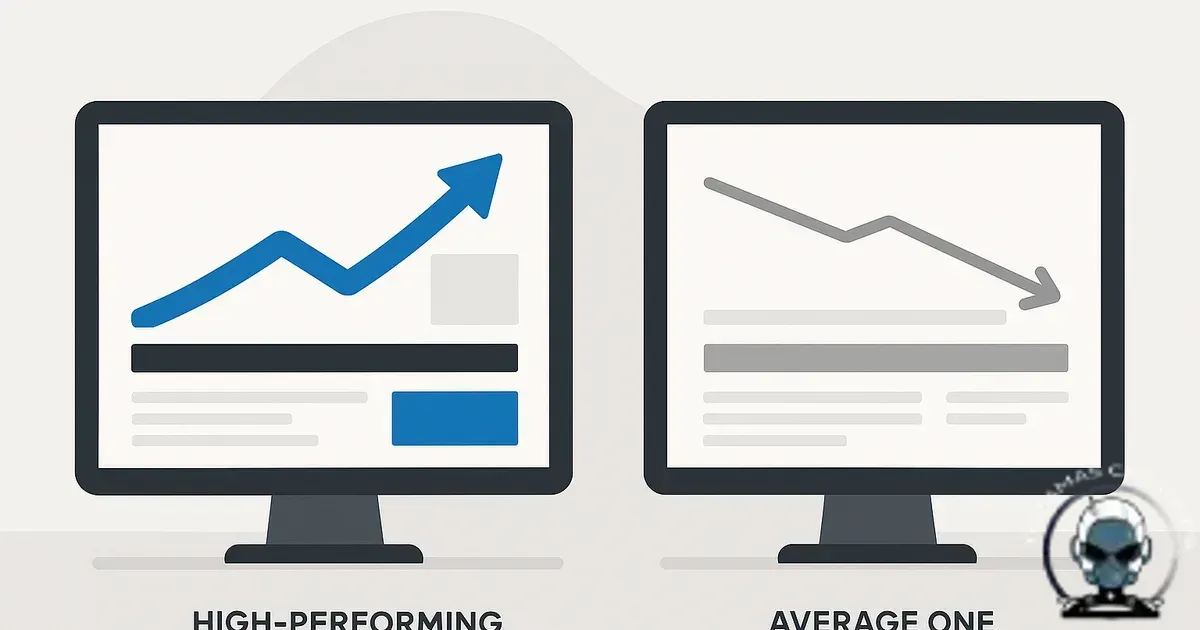
Two websites can look identical and perform nothing alike
A high-performing website isn’t the one with the prettiest design. It’s the one with a solid underlying structure: Google can crawl it without friction, authority flows where you intend it to, new pages slot in without breaking the logic, and the key pages are built to convert without needing a rebuild six months later.
You see the difference quickly when you compare two common approaches. Site A is built in a page builder like Elementor or Divi, resembling a digital brochure: lots of bespoke sections, animations, and one-off layouts. Site B still looks sharp, but it’s engineered: consistent templates, deliberate information architecture, and technical choices made with crawling, indexing, and user intent front of mind. Both might win design awards. Only one tends to grow reliably.
Crawlability: the difference between “Google can see it” and “Google can understand it”
Most sites aren’t blocked from crawling. They’re just messy to interpret at scale. The issue is rarely one catastrophic error; it’s the accumulation of small structural decisions that create uncertainty: duplicated page types, inconsistent internal linking, thin supporting pages, and content tucked away in tabs, sliders, accordions, or JavaScript-heavy components that no one properly tested.
High-performing sites make crawling boring (in the best way). Clean URL patterns, stable canonical rules, and predictable templates mean Googlebot isn’t wasting time finding the same thing five different ways. You end up with fewer “Discovered – currently not indexed” headaches and less index bloat from tag archives, parameter URLs, and auto-generated pages that were never meant to rank.
A classic “visual build” mistake is treating navigation as decoration. If primary navigation changes from template to template, or key category pages are buried inside mega menus that don’t render cleanly, you’re asking Google to guess what matters. A structural build makes the hierarchy obvious: top-level services, sensible sub-services, location or industry variants only where they genuinely make sense, and a clear path from broad to specific.
If you’ve ever launched a redesign and watched rankings wobble for months, it’s usually because crawl paths and canonical signals shifted and nobody mapped the downstream impact. We’ve unpacked that pattern in Why Most Redesigns Fail to Improve Rankings.
Authority flow: how strong sites “push” relevance through the right pages
Most small business sites have some authority, even with a modest backlink profile. The problem is it doesn’t travel well. Average sites bleed it into dead ends: orphan pages, old campaign landing pages, bloated blog archives, or near-duplicate service pages created because someone wanted a slightly different heading for ads.
High-performing sites treat internal linking like plumbing. The point isn’t to link everything to everything. It’s to make sure the pages that should rank receive consistent, relevant internal signals from the right supporting pages.
Structurally built sites usually have an intentional content-to-service relationship. Supporting articles aren’t there to “have a blog”; they exist to strengthen the right commercial pages with sensible anchors, and they’re grouped in a way that builds topical depth. When it’s done properly, you’ll often see rankings lift without any new backlinks, simply because the site finally uses its existing authority efficiently.
A visual build often heads the other way. You get “nice” pages that don’t belong to a system, so internal links are added on the fly. Over time the site turns into a collection of islands, with the home page acting as the only real hub (and a bottleneck). For a deeper look at why this matters for smaller sites, Why Internal Linking Is the Most Underrated SEO Strategy for Small Businesses is worth your time.
Scalability: adding pages without adding chaos
Scalability is where the “built visually” approach usually unravels. It’s fine when you’ve got five service pages and a contact page. Then the business grows: new services, new locations, new industries, lead magnets, and ad landing pages. If the site wasn’t designed with a taxonomy and page model from the start, every new addition becomes a custom job.
High-performing sites scale because they run on rules. Service pages follow a consistent structure. Sub-services sit under a parent service. Supporting content is organised to reinforce those clusters instead of drifting into unrelated topics. The CMS is set up to support that structure, not fight it: reusable components, consistent headings, and templates that don’t require a developer to handcraft every new page.
The technical side of scalability gets missed as well. Average sites slowly collect plugins, scripts, and tracking tags every time someone tries a new tool. Each one adds weight and risk. High-performing sites keep the stack lean and intentional, and they work to a performance budget so speed doesn’t quietly degrade as the site expands.
Scalability isn’t just “can we add pages”. It’s “can we add pages without creating duplicates, cannibalisation, or a navigation system that no longer reflects the business”. When the structure isn’t there, SEO becomes permanent clean-up instead of compounding gains.
Conversion readiness: when the page is built to close, not just to impress
Average sites often convert poorly for a straightforward reason: the page is designed like a poster. It looks good, but it doesn’t answer the questions a buyer has right before they enquire. You see broad claims, forgettable testimonials, and a single CTA buried at the bottom after a long scroll.
High-performing sites treat conversion as part of the architecture. The page opens with clarity: who it’s for, what problem it solves, and what happens next. Proof is specific. Not “we’re trusted”, but evidence that matches the service: case studies, before-and-after metrics, examples of deliverables, process detail that reduces perceived risk, and FAQs that address the friction points you hear on sales calls.
Structurally built pages also cater for different intent levels. Some visitors are ready to call. Others need to compare options, sanity-check pricing ranges, or understand timelines. A conversion-ready page gives them clear paths without dumping them into a maze. This is where internal linking and hierarchy matter again—this time for humans, not crawlers.
There’s a technical conversion layer too. Forms should be fast, accessible, and tracked properly. Events need to be measured consistently across templates. If you can’t trust your analytics, you end up making design decisions based on gut feel. High-performing sites bake measurement into the build rather than tacking it on later.
The structural build mindset: fewer surprises, more compounding
When a website is built structurally, you’re not relying on a hero section and a few clever animations to do the heavy lifting. You’re relying on a system: easy for search engines to crawl and interpret, easy for authority to reach the pages that matter, easy for the business to expand without rebuilding, and easy for visitors to take the next step.
That’s the separation we see again and again. An average site is a collection of pages. A high-performing site is an engine—rules, pathways, and feedback loops. It’s less glamorous to build, but it’s the one that keeps improving six, twelve, and twenty-four months after launch.
Practical signs you’re dealing with a “visual build” site
- New pages take too long because everything is custom and nothing is templated.
- Service pages overlap and compete because there’s no clear hierarchy or intent mapping.
- Internal links are inconsistent, often added only in footers or random body text.
- Index coverage reports show lots of low-value URLs getting discovered.
- Conversion tracking is patchy, and no one trusts the numbers.
When you rebuild, build the structure first
If you’re planning a redesign, treat the visual layer as the last 20 per cent. Start with architecture, crawl paths, canonical rules, and a page model that matches how you sell. When SEO gets bolted on after the site is “finished”, you end up reworking templates, rewriting navigation, and untangling indexing problems that were baked in from day one. We see that exact sequence play out in What Happens When Your SEO is Added After Your Website Is Built.
Sources & Further Reading
- Google Search Central: Crawl budget
- Google Search Central: Link best practices for Google
- Google Search Central: Managing crawling of faceted navigation URLs
- Google Search Central: Canonicalization
- Google Search Central: Core Web Vitals
- Google Search Central – SEO Starter Guide
- Moz – How to Build a Website That Ranks Well
- HubSpot – What is Website Performance? How to Improve It
- Australian Government – Digital Transformation Agency: Web Accessibility and Usability
- Search Engine Journal – Technical SEO: The Complete Guide

Want a website built to scale and convert?
We can build, host and manage a site with the structure your SEO and leads need.
Get in TouchComments
No comments yet. Be the first to join the conversation!



Leave a Comment
Your email address will not be published. Required fields are marked *