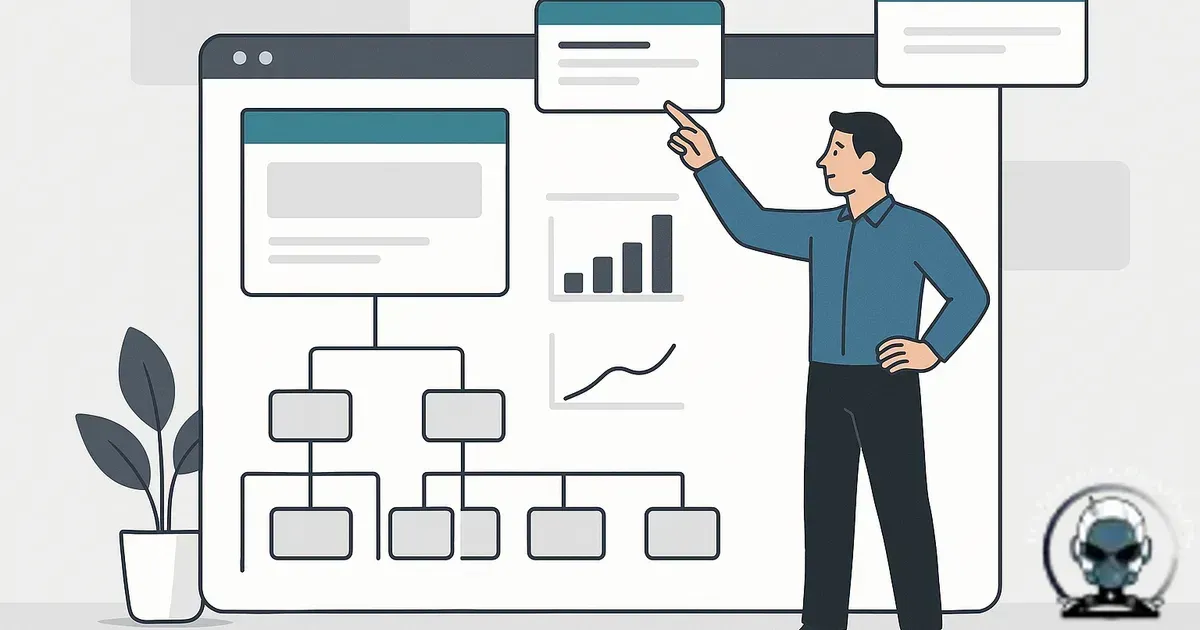
Scaling starts with structure, not a redesign
Building a website that scales with your business means planning for change from day one: new services, new locations, new industries, new campaigns, and new content that needs to rank. If the underlying structure is tight, growth is additive. If it’s messy, every “quick new page” becomes a patch job that costs more and converts less.
As of June 2026, most small business sites hit a wall after the initial build because the navigation, service pages and URLs weren’t designed to expand. The result is duplicated pages, confusing menus, thin content, and SEO cannibalisation where multiple pages compete for the same searches.
The fix is straightforward. Treat your site like a system, not a brochure: expandable service architecture, a clear content hierarchy, and a landing page framework that can scale without breaking the user experience or your search visibility.
1) Expandable service architecture (so new offerings don’t break your site)
Your service architecture is how services are grouped, named, and connected. It’s the difference between a site that can add five new offerings cleanly, and a site that ends up with “Services 2”, random subpages, and a menu nobody uses.
Start with service “families”, not a flat list
Most businesses grow by adding variations of what already works. Build around that reality by grouping services into families that can hold child pages.
Family (pillar): Web Design
Children (expandable): Ecommerce Web Design, WordPress Builds, Website Redesigns, Landing Pages, Accessibility Improvements
The pillar page becomes the overview and trust-builder. Child pages become specific, searchable, conversion-focused pages that you can add over time.
Use URL patterns that won’t fight you later
Clean URL structure makes scaling predictable and keeps analytics, tracking, and SEO tidy.
Good: /services/web-design/ and /services/web-design/ecommerce/
Avoid: /web-design-service-brisbane-2026/ (locks you into a moment in time)
Avoid: /services-page-1/ (guarantees a restructure later)
Pick a pattern you can stick with for years. Consistency beats cleverness.
Design the navigation for growth, not today’s menu length
Navigation should reflect your service families, not every single thing you do. If the menu tries to carry every offering, it becomes unusable as you grow.
Top nav: 5 to 7 primary items maximum (varies by audience, but restraint matters)
Services dropdown: service families only
Child service discovery: internal links on pillar pages, side navigation on service hubs, and “related services” modules
This keeps the site browseable while still allowing deep expansion underneath.
Build internal linking rules into the template
Scaling isn’t just adding pages. It’s ensuring they connect properly so users and Google can understand what matters.
Every child service page links back to its pillar
Pillar pages link to all children (and keep them updated)
Related services module links to 2 to 4 adjacent services (not a huge list)
Case studies link to the specific service page that delivered the outcome
If your structure is drifting, it’s usually because internal linking was left to chance. Our view is aligned with why website architecture matters more than design: the structure does the heavy lifting once the site grows.
2) Content hierarchy planning (so your site stays clear as content multiplies)
Content hierarchy is the map of what content exists, how important each part is, and how people are expected to move through it. This is where most “nice-looking” sites quietly fail, because everything is presented like it’s equally important.
Decide what your site is trying to rank for (before you write a page)
For most Australian small businesses, your early wins come from high-intent searches tied to a service and an outcome. A scalable hierarchy supports both broad and specific intent.
Broad intent: “web design agency” or “SEO services”
Specific intent: “ecommerce web design for tradies” or “local SEO for physiotherapists”
Your pillar pages target broader intent. Your child pages and landing pages capture the specific searches that increase as you specialise.
Use a repeatable page ladder
A scalable site uses a consistent ladder of page types. Here’s a model that works for many service businesses:
Home: who you help, core outcomes, proof
Service pillars: what the service is, who it suits, process, proof, FAQs
Child services: specific use cases, deliverables, timelines, examples, objections
Industries (optional): tailored context and proof for niches you genuinely serve
Locations (optional): only if you have real presence and proof, not templated suburb spam
Insights/blog: education that supports decision-making and captures research-stage traffic
Case studies: outcomes tied back to relevant services
The key is repeatability. If every new page needs a custom layout and bespoke logic, you will stop publishing when you get busy.
Make “proof” a first-class content type
As you scale, trust assets become harder to keep consistent. Don’t bury them in random places.
Standardise testimonials with industry, service, and outcome tags
Build case study templates so new wins can be published quickly
Add a reusable “results” block across service pages (metrics where possible)
This reduces the temptation to rewrite your pitch every time you add a new page. The proof does the work.
3) Future landing page scalability (so campaigns can launch without chaos)
Landing pages are where growth usually gets stuck. You run a new offer, partnership, or ad campaign, then realise the site has nowhere clean to put it. So someone creates a page outside the system, and it never gets maintained.
Create a dedicated landing page framework
Separate campaign landing pages from core services so you can launch fast without messing with navigation or confusing SEO signals.
Campaign hub: /landing-pages/ (or /campaigns/)
Consistent pattern: /landing-pages/seo-audit/ or /campaigns/google-ads-offer/
Governance: each landing page has an owner, a goal, and a review date
You can still internally link to them when it makes sense, but they shouldn’t become your default “service page” because they’re built to convert, not to explain your full offering.
Build landing pages from modules, not one-off designs
When landing pages are modular, you can build variations quickly without breaking brand consistency or accessibility.
Hero with a single clear outcome and primary CTA
Problem-to-solution section (plain language, no jargon)
Offer details and inclusions
Proof block (testimonials, mini case study, logos if appropriate)
Process steps
FAQs (genuine objections, not filler)
Secondary CTA and contact options
With this approach, you can run five campaigns in a year without needing five separate design projects.
Plan for SEO and ads to coexist without cannibalising each other
Campaign pages and SEO pages often collide when they target the same keywords. Decide which page is the long-term “owner” of the topic.
Evergreen search topic: build a service or child service page as the SEO asset
Short-term offer: build a landing page and keep it clearly offer-focused
If both must exist: differentiate intent and messaging (offer vs explanation), and link appropriately
When businesses ignore this, they end up with multiple weak pages instead of one strong one. That’s a common reason sites plateau after launch. If you’re seeing this pattern already, why most websites plateau after launch (and how to fix it) will feel familiar.
A practical checklist before you build (or rebuild)
Define 3 to 6 service families that can hold child pages
Choose a URL structure you can scale (and document it)
Build pillar and child service templates with internal linking rules
Set a page ladder so new content fits naturally into the hierarchy
Create a landing page hub and modular landing page template
Assign ownership and review dates for campaign pages
Decide the “SEO owner” page for each topic to avoid cannibalisation
When scaling is planned, growth stays cheap
A scalable website reduces future friction. New services become new child pages, not a navigation argument. New campaigns launch as clean landing pages, not messy one-offs. Content growth strengthens the site instead of diluting it.
If you want a site built to expand without constant rebuilds, TOZAMAS Creatives can design the architecture, templates, and landing page framework, then host and manage it long-term under our approach: Your Website. Built, Hosted & Managed — So You Don't Have To.
Scaling structure is what creates compounding returns
When your service families, URL patterns and internal linking rules stay consistent, each new page does more than rank on its own. It reinforces the entity signals of the whole site, strengthens topical relevance, and makes it easier for Google to trust the next service or location page you publish. That’s where the real growth comes from over time, which we break down further in The Compounding Effect of a Properly Built Website for Australian Small Businesses.
Sources & Further Reading
- Google Search Central: Site structure (developer documentation)
- Google Search Central: Create helpful, reliable, people-first content
- Nielsen Norman Group: Information Architecture (IA)
- Nielsen Norman Group: Internal links in UX
- Google Search Central: Avoid duplicate content (canonicalisation guidance)
- Google Search Central: SEO Starter Guide
- HubSpot Blog: How to Build a Website That Scales With Your Business
- Moz: Site Architecture for SEO
- Australian Government Business: Build your online presence
- Nielsen Norman Group: Information Architecture Basics
- Search Engine Journal: How to Create Scalable Website Architecture

Build for Where You’re Going
Your website should grow with your business, not restrict it. We design scalable digital infrastructure engineered for expansion.
Start Your Structured BuildComments
No comments yet. Be the first to join the conversation!



Leave a Comment
Your email address will not be published. Required fields are marked *