
The compounding effect of a properly built website shows up when every new page, service update, and case study strengthens what you already have, instead of creating more mess to fix later. Most Australian small businesses launch a site like it’s a brochure, then watch it slowly decay as plugins, themes, tracking, content, and “quick fixes” pile up. According to recent research, 70% of businesses that prioritize a strong digital architecture see a significant increase in both user engagement and overall discoverability, reinforcing the importance of maintaining a well structured website.
Why most websites decay after launch
Websites usually slide backwards for three reasons.
- Technical debt grows quietly. Small changes are made without standards. A new form is bolted on. A landing page is duplicated. Redirects are forgotten. Speed drops and pages become harder for Google to interpret.
- Content gets added without a structure. Blog posts are published as one-offs. Service pages overlap. Location pages cannibalise each other. Rankings become unstable because the site can’t clearly signal what it’s actually authoritative in.
- Trust signals stay thin. The site says one thing, Google Business Profile says another, ABN details are missing or inconsistent, and authorship is vague. That weakens perceived legitimacy, especially in higher-trust categories like health, finance, trades, and legal.
If this feels familiar, it’s not a “Google problem”. It’s architecture.
Digital architecture is what makes growth compound
Digital architecture is the way your website is structured, coded, interconnected, and maintained so it can scale without breaking. When it’s done properly, new content doesn’t compete with old content. It reinforces it.
A compounding site typically has:
- A deliberate information architecture (clear service taxonomy, logical URL structure, and strong internal linking).
- Templates that enforce consistency (headings, FAQs, calls-to-action, and schema patterns).
- Clean, maintainable code that loads fast and doesn’t rely on fragile workarounds.
- Measurement built in so decisions are based on real enquiry, call, and lead data, not vanity traffic.
If your site has grown organically over time and now feels “touchy”, it’s worth reading Why Website Architecture Matters More Than Design.
E-E-A-T is easier to build when the foundations are right
Google doesn’t rank “nice websites”. It ranks results it can understand and trust. E-E-A-T (Experience, Expertise, Authoritativeness, Trust) isn’t a checklist you slap onto a homepage. It’s a pattern you reinforce across the whole site. 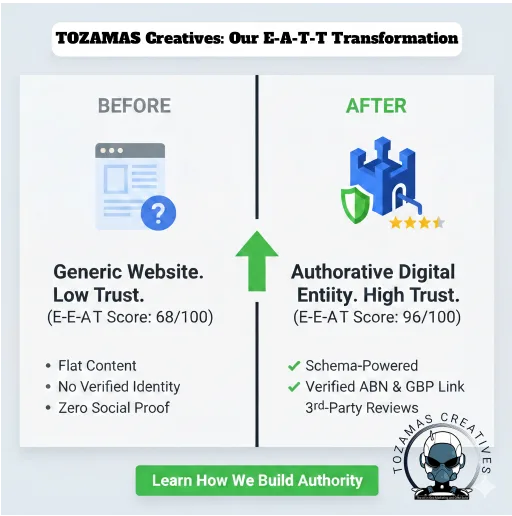
Practical E-E-A-T improvements that compound
- Real authorship: add author pages for key contributors, include qualifications where relevant, and link to professional profiles (without turning it into a brag page).
- Transparent business details: clear contact info, service area, ABN/ACN where appropriate, and policies that match what you actually do.
- Proof over claims: project photos, case studies, before/after outcomes, testimonials tied to real services, and accreditation logos that link to the issuing body (where possible).
- Content written from experience: explain your process, common failure points, safety considerations, timelines, and what affects price. These are the details competitors avoid, and they help buyers commit.
When the site structure is clean, these signals aren’t scattered. They’re discoverable and consistent, which is what search engines and customers respond to.
Structured data (Schema) turns your site into a machine-readable asset
Schema is not a “rank me higher” switch. It’s a way to reduce ambiguity. It helps Google connect the dots between your business, your services, your location, your reviews, and your content.
Schema that matters for Australian SMEs
- Organisation schema: consistent name, logo, URL, contact points, and social/profile links.
- LocalBusiness schema: address, phone, opening hours, service area, and geo where relevant.
- Service schema (or structured service content): what you do, who it’s for, and how it’s delivered. This supports clearer topical authority around your offerings.
- FAQ schema: best used on service pages where questions are genuinely part of buying decisions (not fluff).
- Review and rating schema: only when it complies with Google’s rules and reflects on-page content.
The compounding benefit: each new page you add can re-use a proven schema pattern, so Google ingests it faster and with less confusion. You spend less time “waiting for SEO to kick in” because the site is consistently readable.
Entity reconciliation: link your ABN, business name, and profiles properly
For many local businesses, the trust problem isn’t content quality. It’s identity fragmentation. Google has to be confident that the website, the Google Business Profile, and external citations are the same entity.
Action steps to tighten entity signals
- Standardise your business name: use one legal/trading name across your website header/footer, contact page, and key citations.
- Make NAP consistent: name, address, phone. Match formatting across your site and Google Business Profile.
- Reference your ABN where appropriate: particularly on contact, footer, and invoice-related pages. If you operate under a trading name, be clear about the relationship.
- Link out to the right profiles: your Google Business Profile (where shareable), key industry directories, and official social pages. Then ensure those profiles link back to the same canonical domain.
- Use the same logo and core imagery: it sounds minor, but consistent brand assets across properties reduce ambiguity.
This is one of the fastest ways to improve trust without “writing more blog posts”. It also reduces the risk of ranking volatility when Google re-evaluates local results.
Clean code reduces technical debt and protects conversions
Clean code is not about perfection. It’s about predictability. If your site relies on a stack of third-party scripts, patched themes, and page-level hacks, every change becomes risky and expensive. That’s how sites stall.
What “clean” looks like in practice
- Fast, stable performance: measured with Core Web Vitals, not “feels okay on my phone”.
- Accessible markup: proper headings, labels, focus states, and contrast. Accessibility improvements often improve usability and conversions too.
- Controlled plugin and script bloat: fewer moving parts, clear purpose for every add-on, and a plan for updates.
- Canonical and indexation hygiene: no accidental duplicates, no thin pages indexed by mistake, and redirects handled properly.
When these foundations are stable, you can publish and iterate confidently. That’s the compounding effect in the real world: marketing can move without breaking the site.
How compounding content actually works (and what to publish next)
Compounding content is built around clusters, not random topics. Think of it like building a showroom where every aisle leads somewhere useful, rather than a warehouse of disconnected posts.
A practical structure for most service businesses
- One “money” service page per core service (your main conversion pages).
- Supporting pages for sub-services, industries, or use cases that clarify scope and intent.
- Proof pages: case studies, project galleries, testimonials, and process pages.
- Decision-support content: pricing factors, timeframes, comparison guides, and “common problems we fix”.
- Maintenance content: update older pages quarterly with new examples, updated screenshots, and changes in standards or regulations.
Internally link everything with intention: supporting pages point to the main service page, and the service page links back out to proof and FAQs. If you need a deeper framework for sustaining momentum, Why Most Websites Plateau After Launch (and How to Fix It) pairs well with this approach.
A monthly compounding checklist (60–90 minutes)
- Publish or upgrade one page that directly supports a core service (new case study, new FAQ section, clearer inclusions/exclusions).
- Add 3 to 5 internal links from relevant older pages to the updated page, using natural anchor text.
- Check Search Console for pages with rising impressions but low CTR, then adjust titles/meta descriptions and add clearer on-page answers.
- Review Core Web Vitals for any sudden drops after updates or new scripts.
- Confirm entity consistency if anything changed (phone number, address, trading name, service area).
Do this consistently and the site behaves less like a brochure and more like an asset. Rankings strengthen because the structure gets clearer, not noisier. Enquiries improve because pages match real buyer questions and reduce friction.
What to avoid if you want compounding growth
- Publishing content that doesn’t connect to a service. If it can’t naturally link to a money page, it’s usually distraction.
- Duplicating location pages with swapped suburb names. It creates thin pages and cannibalisation, and it rarely converts well.
- Letting too many people “just tweak it”. That’s how standards disappear and the site becomes unmaintainable.
- Chasing tools over fundamentals. Schema, speed, and structure beat a new AI plugin every time.
The real payoff: less rework, more momentum
A properly built website compounds because it reduces friction across the whole system. Google can interpret it faster. Customers can trust it sooner. Your team can update it without breaking it. That’s how you avoid the slow fade into technical debt and instead build organic reach and conversion strength that improves every month.
Sources & Further Reading

Build Once. Grow Continuously.
We design structured digital infrastructure built to strengthen authority and performance over time. Our "Analyse, Optimise, Automate" framework ensures your technical foundation (ABN verification, Schema, and Infrastructure) is ready to scale.
Discuss Your ProjectComments
No comments yet. Be the first to join the conversation!



Leave a Comment
Your email address will not be published. Required fields are marked *