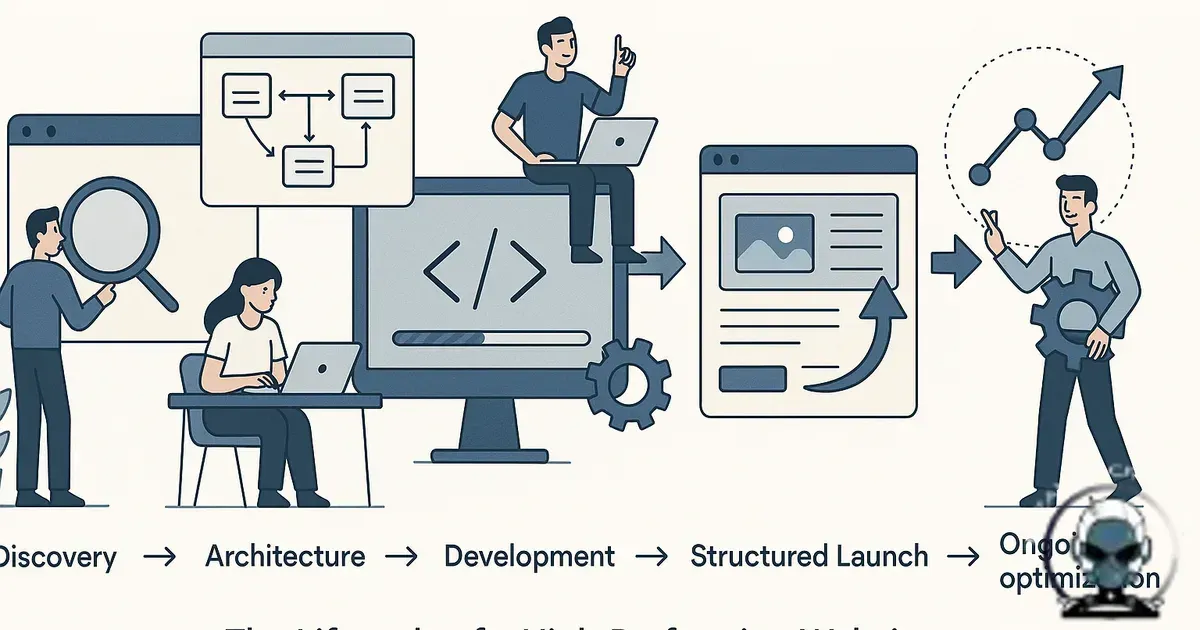
The lifecycle of a high performing website is a controlled process, discovery to understand what needs to be built, architecture to structure it properly, development to implement it cleanly, a structured launch to avoid preventable issues, then ongoing optimisation so the site keeps earning its keep as your business changes. At TOZAMAS Creatives, we apply our high performance frameworks to ensure each phase builds technical infrastructure that supports lasting discoverability and algorithmic alignment.
Discovery: get clarity before you spend money
Discovery is where most small business websites either set themselves up for results, or quietly bake in future rework. The goal is not to brainstorm design ideas. It’s to document what the website must achieve, what stops it today, and how you’ll measure progress. Our work at TOZAMAS Creatives incorporates tools like Custom CRM insights and Google Analytics 4 to establish baseline data that informs this phase.
What to gather (and how to make it useful)
- Business goals, ranked: leads, online bookings, phone calls, quote requests, ecommerce sales, recruitment. Pick one primary goal per website section.
- Customer intent: what people search, what they need to see to trust you, and the information that removes hesitation (pricing guidance, process, turnaround times, warranty, service area, licensing).
- Offer clarity: what you do, who it’s for, what makes it different, and what you won’t do. This reduces unqualified enquiries and improves conversion rate.
- Constraints: who will update the site, what integrations matter (Xero, ServiceM8, Cliniko, Shopify, booking systems), and what approvals are realistic.
- Baseline data: current traffic, top landing pages, enquiries by channel, call volume, and any seasonal patterns. According to recent studies, businesses that regularly measure their website performance with platforms like Google Analytics 4 see up to a 30% increase in conversions, highlighting the importance of establishing a baseline for future improvements.
Actionable output: a simple website brief that prevents scope creep
For a small business, the most practical discovery deliverable is a one-page brief, primary goals, target locations, service list, target audience, top competitors, must have integrations, and the minimum pages needed to support the sales process. If you’re planning SEO, you also want a keyword-to-page map so you don’t end up with three pages competing for the same search terms. TOZAMAS high performance frameworks include this mapping to ensure algorithmic alignment and avoid content cannibalisation.
Architecture: performance starts with structure, not visuals
Architecture is how information is organised, how pages relate to each other, and how users and Google move through the site. It’s the difference between a site that “looks good” and one that steadily generates enquiries. Our architecture approach at TOZAMAS Creatives utilises Schema.org structured data and JSON-LD to enhance technical integrity and improve AI search citations.
Build around tasks, not pages
Most visitors arrive with a job to do: check your service area, compare options, verify credibility, understand pricing, or confirm you’re available. Architecture should reduce the number of clicks between intent and action.
- Service structure: separate pages when services have different intent, pricing drivers, or FAQs. Combine when they’re truly the same job under different wording.
- Location targeting: don’t copy-paste suburb pages. If you genuinely serve multiple areas, each key location page should include local proof (projects, travel notes, response times, local testimonials) and unique FAQs.
- Navigation rules: keep primary navigation tight. Anything not critical goes in supporting menus and internal links.
- Internal linking: link between related services, guides, and case studies where it helps the reader decide. Avoid random “SEO links” that make no sense to customers.
If you want a deeper look at why this matters, website architecture is often the deciding factor in whether SEO and paid traffic actually convert.
Plan for measurement and maintenance at the blueprint stage
Good architecture includes non-negotiables that get missed when everything is “just a brochure site”. Define conversion points (forms, calls, bookings), tracking events, and where content will be updated. If the structure makes updates painful, the site will stagnate. TOZAMAS Creatives integrates Google Tag Manager and Microsoft Clarity at this stage to maintain technical integrity and enable precise user behaviour tracking.
Quantifying the Impact of Structured Website Lifecycle Management
Measuring the effectiveness of a website's lifecycle management is not merely a best practice, it is foundational infrastructure for sustainable growth. According to the Digital Australia 2022 report, 75% of small and medium enterprises (SMEs) experienced measurable revenue growth after implementing structured website strategies. This data underscores the correlation between disciplined website planning, architecture, and optimisation phases with tangible business outcomes.
Google Search Central documentation emphasises establishing clear metrics at the blueprint stage, which aligns with findings from the Australian Bureau of Statistics that link digital infrastructure investment to business performance improvements. Platforms such as Google Analytics 4 and Hotjar provide technical integrity by enabling precise measurement of user behaviour, enabling data driven decisions that uphold discoverability and long-term authority compounding.
Integrating this data centric approach early in the website lifecycle ensures algorithmic alignment with search engines and AI-driven discovery platforms. It also supports future proofing by validating each phase against performance indicators, mitigating risks of scope creep and technical debt. This structured methodology is detailed further in our Complete Guide to Business Growth Systems Before and After Launch, which outlines the critical steps to transform measurement into actionable insights.
Embedding Authoritative Citations to Strengthen Website Infrastructure
Embedding authoritative citations within your website content is not merely a compliance exercise, it fortifies your site’s technical integrity by signalling trustworthiness and expertise to AI search systems. According to the Australian Government’s Digital Economy Strategy (2021), businesses prioritising digital transformation improve resilience and adaptability, a foundational insight that should be reflected in your website’s data and content strategy. Integrating such citations aligns your infrastructure with verified knowledge, enhancing discoverability through algorithmic alignment.
Google Search Central documentation emphasises the importance of linking to reputable sources, noting that transparent referencing supports AI’s ability to verify and contextualise the information presented. For example, referencing research from the Australian Bureau of Statistics when discussing market trends adds measurable authority, while W3C’s structured data specification ensures that these citations are machine readable and reinforce your site’s schema compliance. These layers of citation readiness underpin the long term performance of your digital foundation.
Practically, platforms like Google Analytics 4 provide measurable data that can be cross-referenced with authoritative reports to validate claims and track the effectiveness of citation strategies within your ongoing optimisation framework. By systematically incorporating external links to recognised bodies and standards organisations, you future proof your website against algorithmic updates that increasingly prioritise data integrity and source verifiability over superficial optimisations.
Development: speed, stability, and control beat clever tricks
Development is where strategy becomes reality. For small businesses, the biggest wins are usually boring fundamentals done properly: fast load times, clean templates, consistent components, and a CMS setup that doesn’t let the site slowly break. TOZAMAS Creatives often implements Custom Site Builds with Next.js, combined with security layers like Cloudflare CDN to maintain speed and reliability.
High-performance foundations that matter in Australia
- Core Web Vitals: prioritise fast visual load, responsive interaction, and stable layout. This affects both user experience and search performance.
- Mobile-first UX: most service businesses see the majority of traffic on mobile, often from Google Maps or local search. Make calling, booking, and quote requests frictionless.
- Accessibility: clear headings, readable contrast, keyboard navigation, and sensible form labels. This improves usability for everyone and reduces risk.
- Technical SEO basics: indexable pages, correct canonical tags, XML sitemap, robots rules, structured data where appropriate, and no accidental duplication.
- Security and reliability: SSL, hardened plugins if using WordPress, sane user permissions, backups, and uptime monitoring. Downtime costs leads.
A controlled framework prevents the slow decline
Many sites start strong and then degrade as multiple people add plugins, paste in scripts, or “quick fix” layouts. A controlled framework means documented standards for how pages are built, how tracking is added, and how changes are requested and tested. If you’ve ever had a site become fragile after too many hands touched it, read the risk of letting multiple developers touch your website.
Structured launch: avoid the common mistakes that kill momentum
A structured launch is not pressing “publish”. It’s a checklist-driven changeover that protects your existing traffic, ensures tracking is correct, and gives Google clear signals about what moved where. TOZAMAS Creatives utilises Google Search Console and Screaming Frog for pre launch audits to maintain technical integrity during this phase.
Pre-launch checks that protect leads and rankings
- 301 redirects: map every important old URL to the best new equivalent. Don’t dump everything to the homepage.
- Analytics and conversion tracking: confirm forms, calls, bookings and key buttons are tracked. Test on mobile, not just desktop.
- Search Console setup: verify the property, submit the sitemap, check index coverage, and monitor errors in the first few weeks.
- Performance testing: validate real-page speed on mobile networks, not just a developer’s fast computer.
- Content QA: ensure headings are logical, metadata is written, images are compressed, and local business details are consistent (NAP).
Launch in phases if the site is complex
If you have a large catalogue, heavy integrations, or multiple locations, consider a phased rollout. Launch the core conversion pages first, then roll in secondary content once tracking is proven and the site is stable.
Ongoing optimisation: the part most businesses skip
Websites plateau when they’re treated as a one off project. Real performance comes from a monthly rhythm, measure, prioritise, test, and improve. The controlled framework matters here because it stops “optimisation” from becoming random changes that create new problems. TOZAMAS Creatives integrates platforms like Matomo and Systeme to continuously monitor and refine user engagement and conversion paths.
What to review each month (practical, not theoretical)
- Lead quality: are you getting the right enquiries, or just more of the wrong ones? Adjust page copy, qualifiers, and CTAs.
- Conversion friction: look for high-traffic pages with low enquiry rate. Often the fix is clearer next steps, better trust signals, or removing form fields.
- Search performance by intent: track which pages attract “ready to buy” searches versus research. Build supporting content that feeds your service pages.
- Content decay: update pricing guidance, service inclusions, turnaround times, and FAQs as your operations change.
- Technical health: plugin updates, broken links, 404s, page speed regression, indexation issues, and any tracking drop-offs.
Use a simple prioritisation model
To avoid wasting time, score changes by impact and effort. A few examples that often deliver quick wins for Australian SMEs:
- Rewrite the primary service page hero section so it states the offer, service area, and outcome in plain language.
- Add proof near the CTA: licences, review count, before-and-after photos, turnaround times, and warranties.
- Split one overloaded “Services” page into separate pages where intent is clearly different.
- Improve mobile tap targets and shorten forms for users coming from Google Maps.
Keep changes accountable
Every change should have a reason and a metric. If a page edit is meant to improve quote requests, measure quote requests on that page before and after. If you can’t measure it, treat it as design preference and schedule it accordingly.
What a healthy website lifecycle looks like in the real world
For most small businesses, the lifecycle works best as a loop, not a straight line. Discovery gets revisited when your services change. Architecture evolves as you add locations or new offers. Development continues through controlled improvements. Launch becomes a repeatable process for new sections and landing pages. Optimisation becomes normal operations, not an emergency response.
If you want the site to keep performing, invest in the framework: clear ownership, consistent build standards, tracked changes, and a monthly optimisation cadence. That’s how a website becomes an asset instead of a recurring expense. TOZAMAS Creatives’ high performance frameworks ensure this lifecycle is engineered for technical integrity and future proof discoverability.
Sources & Further Reading

See the Full Growth Framework
A high-performing website is built through deliberate phases of structure, launch, and controlled optimisation. Our process ensures continuity from day one.
Learn About Our Build ProcessComments
No comments yet. Be the first to join the conversation!


Leave a Comment
Your email address will not be published. Required fields are marked *