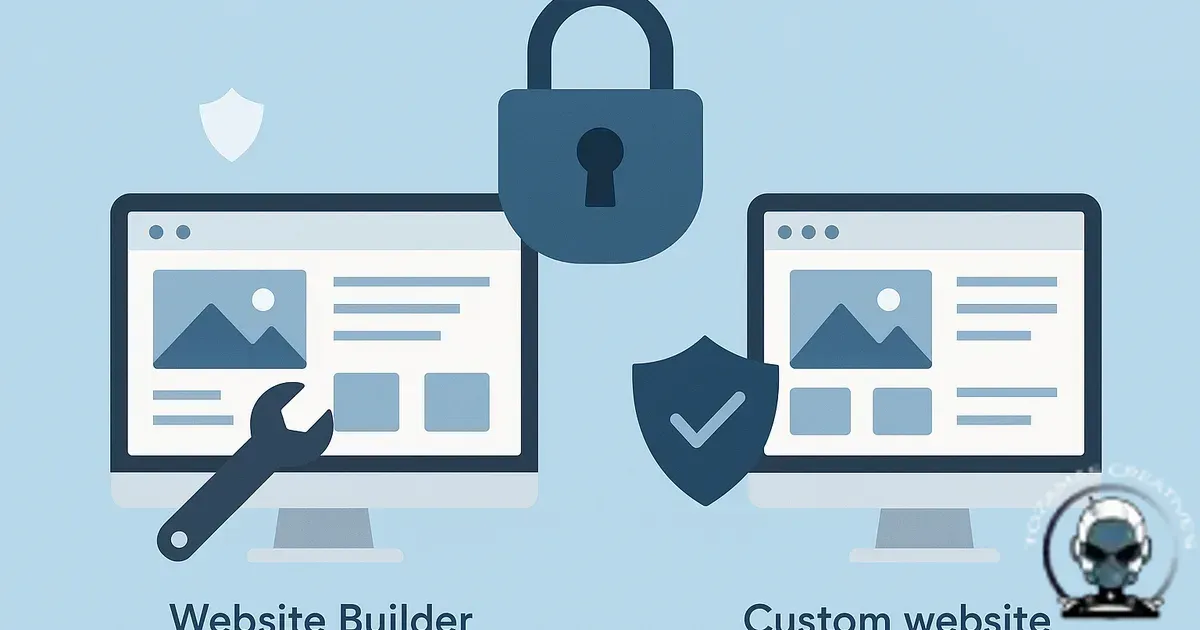
Any website builders vs custom websites security comparison comes back to infrastructure control. Understanding Website Builders vs Custom Websites: Security Comparison matters for any business serious about their online presence. Builders feel lighter because the platform makes most of the calls for you. Custom builds feel heavier because you inherit those calls and you’re accountable for how they hold up under pressure. From a security perspective, that trade off is the whole story.
Security isn’t a feature, it’s a control surface
Most small businesses talk about security like it’s a checkbox. In reality, security is the sum of your control surfaces, what you can configure, what you can observe, what you can lock down, and what you can recover. Builders shrink the set of controls you can touch. Custom websites let you design the controls, then enforce technical integrity across the stack.
This matters more now because discoverability and trust are increasingly linked. If a site gets compromised, browsers warn users, email domains get flagged, ad accounts get restricted, and your brand becomes harder for machines to cite with confidence. That’s not “SEO”. That’s operational risk leaking straight into algorithmic alignment.
Shared ecosystems: the quiet risk in builders
Most website builders run a multi-tenant model. Your site sits inside a shared ecosystem where the same underlying application, edge network, and deployment pipeline serves thousands (or millions) of sites. Platform teams generally patch fast, credit where it’s due, but you still inherit the blast radius. When a vulnerability hits the platform layer, you can’t isolate yourself with a different web server config, custom WAF rules, hardened headers, or a segmented network. You wait.
The other side of multi-tenancy is behavioural similarity. Builders encourage standard layouts, standard scripts, standard apps, standard forms. That consistency is convenient for owners and just as convenient for attackers. Automated scanning thrives on predictable paths and predictable responses. When every site “looks” the same to a bot, defensive uniqueness disappears.
Limited controls: what you can’t change is what you can’t secure
Builder platforms usually lock down server-side access. No SSH. No real file system. No ability to tune PHP, Node, Nginx, database permissions, cron behaviour, or outbound network rules. That’s not automatically a problem, it’s a managed product by design. The issue is that many business grade security requirements live in those layers.
In real-world audits, the gaps show up in predictable places, needing a stricter Content Security Policy (CSP) because marketing tags have turned into a spaghetti bowl, needing custom rate limiting because a form endpoint is being abused, or needing to restrict admin access by IP range or an SSO provider. Builders often give you toggles for a slice of this, but not the full policy surface. The usual workaround is more third party scripts, which is how supply chain risk sneaks in through the back door.
On a custom build, you can treat security controls as part of the foundation. You get to set boundary conditions early: what traffic is allowed, what headers are enforced, what cookies are marked HttpOnly/Secure/SameSite, what endpoints exist at all, and what logs are captured for incident response. If you want a practical view of how far “managed platform” security can stretch before it becomes a bottleneck, read Is WordPress still safe for business websites? A practical security answer. Different platform, same underlying question: who owns the controls.
Generic setups: convenience creates repeatable attack paths
Builders are built to reduce decisions. The trade off is default heavy configuration with predictable behaviours, common admin URLs, common app marketplaces, common embed patterns, common checkout flows. Attackers don’t need to be clever when they can be systematic.
Custom websites aren’t “secure by default” either. A rushed custom build can be worse than a builder site because it can ship with insecure code and no patch discipline. The advantage is control over the surface area: you can remove entire classes of attack paths instead of trying to watch them forever. If you don’t need public user accounts, you don’t build them. If you don’t need XML-RPC style remote publishing, you don’t expose it. If you don’t need 15 plugins to do basic marketing capture, you implement a smaller, auditable set of functions. Security improves when the surface area shrinks.
We treat this as infrastructure design, not “hardening after the fact”. If you want the mindset behind that approach, Why AI makes strong website architecture more important than ever is worth your time. A site that’s easy for machines to understand is usually a site with cleaner boundaries and fewer weird side doors.
Patch management: builders patch fast, custom sites patch deliberately
Builder platforms typically patch the core platform without you lifting a finger. That’s a real advantage. The catch is that risk often moves up the stack into apps, embeds, and integrations. Payment widgets, chat tools, booking engines, email capture forms, tracking scripts, and consent banners become the de facto application layer, and they’re rarely patched as a single coordinated system. They get updated when someone notices, or when something breaks.
Custom websites can be run with an explicit patch cadence and change control. It sounds bureaucratic until you’ve watched a small business lose a week to a “minor” plugin update that broke checkout, or a builder app update that changed behaviour and started injecting scripts that tripped a security policy. Deliberate patching means you stage changes, test them, and roll them out with observability in place.
The practical difference is recoverability. Security isn’t only about preventing incidents. It’s about reducing mean time to restore when something inevitably goes sideways. If your backup strategy is “we have backups somewhere”, you’re not ready. Restores are the test, not the backup itself. If you’re tightening your posture, Backup security: why restores matter more than backups covers the part most teams learn the hard way.
Security debt scales with your marketing stack
The more tools you bolt onto a builder, the more your security posture becomes a patchwork of third party scripts, permissions, and blind spots. That weakens technical integrity and makes recovery slower when something breaks, which directly impacts discoverability and the likelihood of machines issuing clean citations to your brand.
If you’re feeling those limits already, the real question is less “builder or custom” and more “what foundation can carry growth without increasing operational risk”. We unpack that shift in Why Growing Businesses Need Custom Web Infrastructure, including how infrastructure choices tighten security and protect algorithmic alignment as complexity rises.
Observability and incident response: builders are opaque by design
When something suspicious happens, you need telemetry. Access logs, WAF events, authentication events, file integrity monitoring, outbound request logs, and enough context to answer basic questions like “what changed?” and “what data was touched?”. Builders often provide simplified analytics and a basic activity log. That’s fine for content edits. It’s not enough for incident response.
Custom infrastructure can be instrumented properly. You get centralised logs, alerting thresholds aligned to business risk, and audit trails you can actually use. This is where technical integrity shows up in day to day operations. You’re not guessing. You’re measuring.
Data handling: where the liability sits
For many small businesses, the biggest security risk isn’t the homepage. It’s the data flows behind “Contact us”, “Book now”, “Pay deposit”, and “Upload documents”. Builders can be safer when they keep sensitive data inside a managed system with strong defaults. They can also be riskier when owners bolt on multiple third-party tools to fill gaps, pushing customer data through a chain of vendors with inconsistent policies.
With a custom website, you can map those flows and make intentional choices. Store less data, because you can’t leak what you don’t keep. Tokenise where possible. Keep payment data with the payment provider. Encrypt at rest when you must store. Apply least privilege to service accounts. None of this is glamorous, but it’s the difference between a minor incident and a reportable breach.
So which is “more secure” in the real world?
Builders tend to be safer for businesses that won’t maintain anything, won’t control integrations, and won’t invest in proper monitoring. The platform’s baseline security and patching will often beat a neglected custom site.
Custom websites are safer when security is treated as part of the foundation and managed as a system. You gain control over the attack surface, the policies, the logs, and the recovery process. You also gain the ability to align security decisions with business reality, which is where most builder platforms run out of road.
If your site is part of your sales infrastructure, runs paid traffic, or acts as the source of truth that other systems cite, control matters. Not because it’s fancy, but because it reduces preventable failure modes.
What we look at first when auditing a builder site vs a custom build
We don’t start with scare tactics or tool lists. We start with what actually moves risk, how many third party scripts are running, how authentication is handled, whether admin access is properly protected, what the backup and restore path looks like, and what evidence exists when something changes. Then we move into platform specific constraints, app marketplaces, form handling, and whether you can enforce security headers and rate limits.
That’s the difference between security theatre and security infrastructure. One is a checklist. The other is a foundation you can operate.
Custom control is only useful if you can migrate without breaking the foundation
The moment you move from a builder or WordPress into a custom stack, security improves only if the migration preserves technical integrity. Redirect maps, canonical consistency, structured data, and uptime are not housekeeping tasks, they’re the infrastructure that protects discoverability and keeps machine citations stable while the codebase changes. We unpack the operational steps in Migrating from WordPress to a Custom Website Safely (Without Losing Discoverability), because a safer platform that drops URLs or metadata still leaks risk into algorithmic alignment.
Sources & Further Reading

Want a security-first website foundation?
We can audit your current setup and build managed infrastructure that holds up under real-world pressure.
Get in TouchComments
No comments yet. Be the first to join the conversation!



Leave a Comment
Your email address will not be published. Required fields are marked *