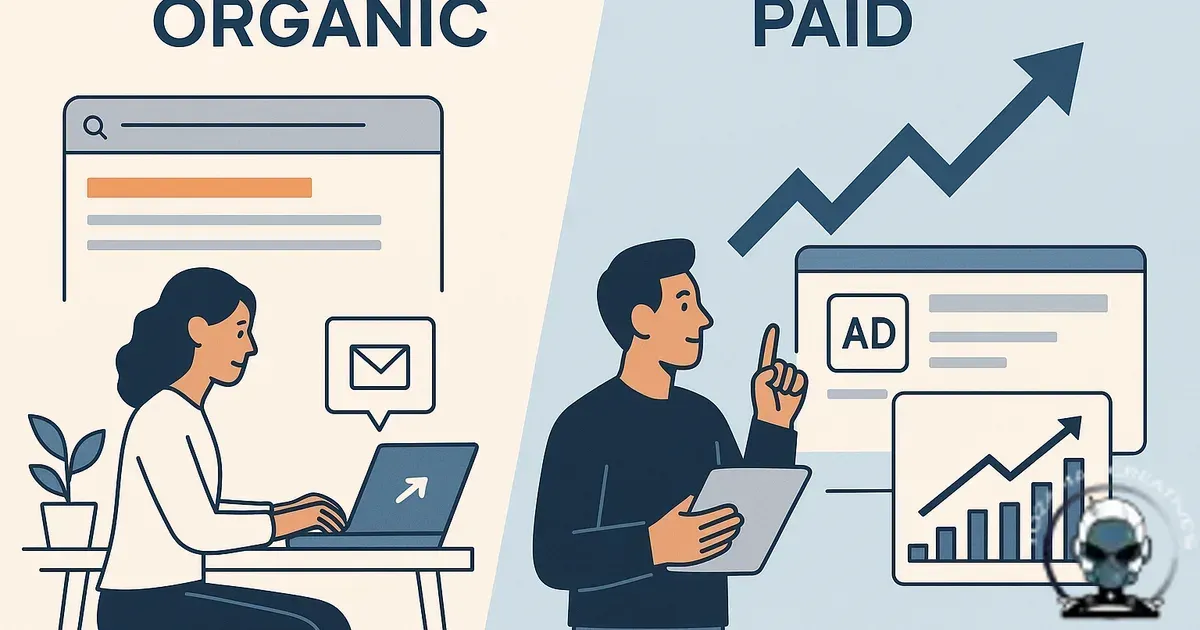
Organic vs paid traffic is a systems problem, not a channel debate
Clarity comes fast when you stop treating traffic as the goal. Understanding organic vs paid traffic matters for any business serious about their online presence. For growing businesses, traffic is just an input into a bigger foundation, discoverability, conversion pathways, and measurement you can trust. If any of those three are unstable, you can spend hard on ads or publish for months and still end up wondering why nothing “works”.
Better outcomes come from treating paid as your controlled test environment and organic as your compounding asset. The mistake is running either one without algorithmic alignment and technical integrity across the site. That’s when ads turn into a leak and organic turns into a long, slow guessing game.
Paid traffic: faster feedback, higher risk when the foundation is weak
Paid traffic gives you feedback with almost no delay. That’s the benefit, you find out quickly whether your offer, landing page, and funnel logic hold up under real attention. The downside is just as practical, if your positioning or conversion pathway isn’t ready, paid can look like “growth” while you’re really just renting attention and burning it.
The failure we see most often isn’t “ads don’t work”. It’s that the website can’t carry the load. Slow pages, fuzzy above the fold messaging, forms that don’t track properly, and thank you pages that aren’t wired into analytics. You end up making decisions off incomplete signals, which is basically flying on instruments that aren’t connected.
Paid performs best when you run it like an engineering loop. You choose one conversion event that matters, lead, booking, purchase, instrument it properly, then iterate on a small set of variables. If you’re changing creative, audience, offer, landing page, and tracking all at once, you’re not optimising, you’re just moving numbers around in a spreadsheet and calling it strategy.
Where paid actually earns its keep
Paid is the right tool when you need controlled volume to validate something, a new offer, new market, new pricing, or a new landing page angle. It’s also the right tool when demand already exists and you’re competing for attention inside a tight window, seasonal services, limited intake, time sensitive promos.
It’s a poor fit when you’re relying on it to create demand for something people don’t yet understand, especially if your site can’t explain the problem with precision. Paid can amplify clarity. It can’t replace it.
Organic traffic: slower compounding, higher dependence on structure
Organic growth gets oversimplified into “post content consistently”. That’s how you end up with a blog full of pages that get indexed but never earn citations from search systems or AI answers. Organic performance is structural, how your information is organised, how entities connect, and whether your pages are the best match for intent.
For advanced teams, the organic conversation moves away from keywords and into information architecture and retrieval. Can a machine understand what you do, where you do it, and why you’re credible? Can it extract a clean answer from your page without guessing? That’s discoverability infrastructure, not just copywriting.
Organic carries a different kind of risk, delayed feedback. You can spend six months publishing and only then realise you built the wrong cluster, targeted the wrong intent, or buried the conversion action under three scrolls of “helpful” context. If you want organic to compound, build it around conversion pathways, not content volume. Our draft on content depth vs content volume goes deeper on why “more pages” is rarely the answer.
Where organic wins, even when paid is available
Organic is the stronger long term bet when buyers research before they contact you, when trust is part of the sale, and when the same questions come up in every sales call. Those repeated questions aren’t just “content ideas”. They’re the blueprint for a scalable knowledge base that supports sales, reduces friction, and earns citations over time.
Organic also cushions you from auction volatility. Ad costs move. Platforms change. Tracking gets harder. A well structured site with strong topical coverage and clean technical signals keeps producing value even when your paid spend fluctuates.
The real decision: what are you trying to learn, and what are you trying to scale?
When a business asks “should we focus on organic or paid?”, we usually translate it into two more useful questions.
First, do you need answers fast? If you’re still validating your offer, paid is the shortest path to feedback, provided your tracking is solid. Second, do you need an asset that compounds? If you’re past basic validation, organic becomes the thing that lowers your cost per acquisition over time because it keeps working after the click is gone.
The trap is trying to scale before you’ve learned. Over investing in ads before your funnel is stable is expensive tuition. Ignoring organic because it’s slow is like refusing to build equity because rent feels simpler this month.
Balance looks like this: paid proves, organic compounds, the website connects them
Resilience comes from using paid to pressure test messaging and offers, then feeding those learnings back into organic pages that answer the same intent. When a paid campaign finds a winning angle, that angle shouldn’t live only in ad copy. It should become part of your permanent foundation, service pages, FAQs, case studies, and comparison content.
This is where a lot of businesses leave money on the table. They run ads, learn what converts, then stop the campaign and keep nothing. If you want compounding growth, every paid test should produce an organic asset or a site improvement that stays.
It works both ways. Organic content should inform paid. Pages that earn consistent organic engagement are telling you what the market cares about. Those themes often become your best ad angles because they’re validated by behaviour, not opinions. If you’re building a broader acquisition machine, our draft on building a traffic system that feeds your website maps this out as an actual system rather than a set of disconnected tactics.
Common failure modes we see (and what to fix first)
1) “We’re spending on ads but leads are poor quality”
Most of the time this is a message to intent mismatch. Your ad promise attracts one type of person, then the landing page speaks to another. Fix the message match first, then tighten the conversion event you optimise for. If you optimise for cheap leads instead of qualified outcomes, the platform will happily deliver exactly what you asked for.
2) “Organic isn’t moving, so we need to boost everything”
Boosting doesn’t fix organic. It hides the real issue. Organic stalls when the site lacks topical structure, when pages cannibalise each other, or when the content doesn’t resolve intent cleanly. Before you publish more, audit what you already have, which pages should be the authority page for each topic, and which pages should support it.
3) “We can’t tell what’s working”
When attribution is messy, you default to the loudest channel. Paid looks measurable because it comes with a dashboard, but that doesn’t mean the data is correct. Start with technical integrity, consent aware analytics configuration, clean conversion definitions, and consistent UTM discipline. If you can’t trust your measurement, you can’t make a rational organic vs paid decision.
What we’d prioritise for a growing business
If you’re in growth mode, the priority isn’t “more traffic”. It’s a foundation that can accept traffic without wasting it. That means a site that loads fast, communicates clearly, tracks accurately, and routes visitors into a conversion pathway that matches intent. Once that’s in place, paid becomes a reliable accelerator and organic becomes a compounding asset instead of a content treadmill.
If you’re currently relying on a single platform for visibility, it’s worth reading why Google Business Profiles alone are not enough. Same underlying issue, dependence on one channel instead of building discoverability infrastructure you control.
Sources & Further Reading

Need a traffic mix that doesn’t waste spend?
We’ll build the measurement and website foundation so organic and paid channels work as one system.
Get in TouchComments
No comments yet. Be the first to join the conversation!

Leave a Comment
Your email address will not be published. Required fields are marked *