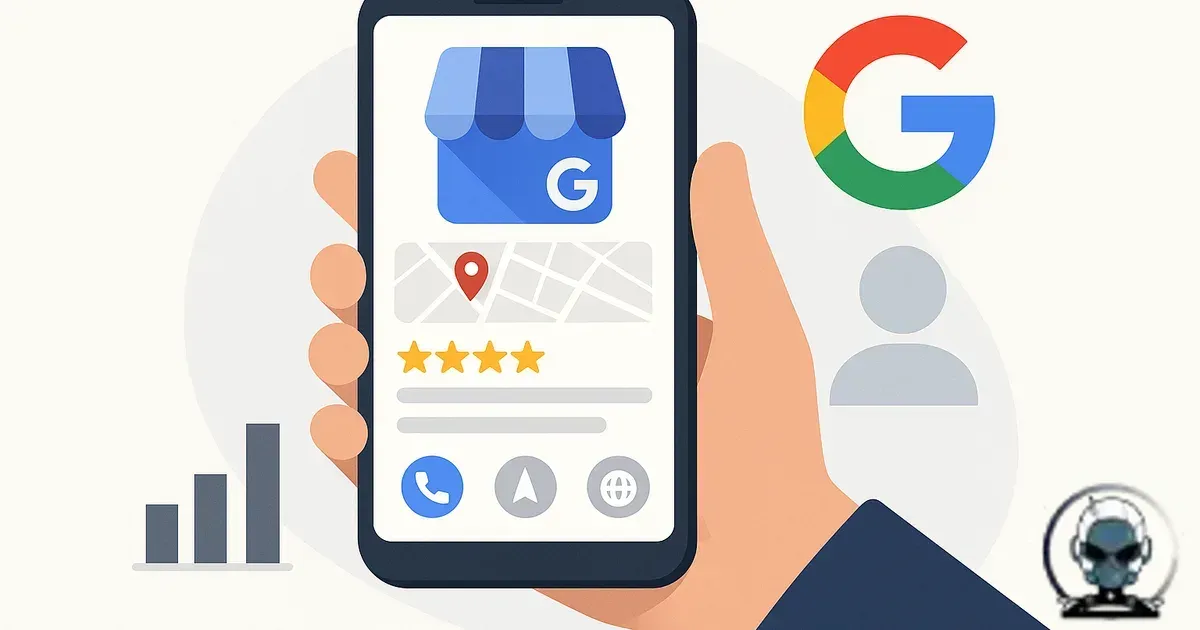
Google Business Profiles are a storefront, not the shop
A Google Business Profile (GBP) on its own won’t carry your marketing. As of June 2026, understanding that Google Business Profiles alone are not enough matters for any business serious about their online presence. It’s an interface you don’t own, with limited control over how you present proof, capture leads, or measure what’s actually working.
For most local businesses, GBP is the first touchpoint. People check your hours, skim reviews, and decide whether you’re worth a call. Where businesses go wrong is treating that as the whole strategy. In reality, GBP performs best when it funnels people to a solid website that does the heavy lifting: building trust, providing detail, converting enquiries, and giving you proper tracking.
What GBP does well, and where it hits a wall
GBP is brilliant at capturing high intent searches. When someone types “emergency plumber near me” or “physio South Brisbane”, the Map Pack can bypass the usual browsing altogether. If your profile is complete and credible, you can win the click or the call.
Then you hit the wall, control. You can’t design the journey. You can’t structure information around how your customers actually make decisions. You can’t run meaningful experiments on messaging. And you can’t assume Google will keep the rules steady. Categories shift, features come and go, suspensions happen, and Google will sometimes rewrite parts of your listing using third party data.
Even at its best, GBP is a compressed version of your business. It’s made to answer quick questions and push an action button, not to explain nuance.
The ownership problem: you’re building on rented land
Your GBP is shaped by Google’s product decisions, not your business needs. That shows up quickly in the real world.
Suspensions and verification loops are common. If you’ve ever had a profile flagged after an address change, a service area update, or a well meaning “helpful” edit from a Local Guide, you know how fast leads can fall off. Recovery might be quick, or it might drag on while you feed documents into a queue.
Reviews are another pressure point. They matter, but you don’t control how they’re filtered, displayed, or weighted. A competitor can’t easily delete your website content, but they can create noise in your review profile that you’re forced to manage inside Google’s system.
A website isn’t immune to platform risk, but it’s still your asset. You control the content, the structure, the calls to action, the analytics, and the way you capture enquiries when a third party platform shifts under your feet.
GBP doesn’t replace a conversion path
GBP actions are blunt, call, directions, website click, message. For a minority of businesses, that’s enough. For most, it isn’t.
When the job is high value or high risk, people want reassurance before they commit. They look for licences, insurances, case studies, before and after photos, what’s included, how you work, your pricing approach, warranties, and clear constraints. GBP can’t carry that depth without becoming a messy scroll of posts and photos with no real narrative.
A strong website gives you a controlled conversion path. You can send different intents to different pages, match the copy to the problem being searched, and reduce friction. A “Book now” button on a profile isn’t the same as a booking flow that answers objections, sets expectations, and qualifies the lead before they land in your calendar.
Local SEO is now a two-system game: Maps and organic
Local visibility isn’t just the Map Pack. Organic results still pull a big share of clicks, particularly for research heavy searches like “best conveyancer for first home buyer”, “commercial electrician compliance”, or “NDIS plan management help”. Those queries often trigger a mix of local results, organic pages, and increasingly AI summaries drawing from web sources.
GBP helps with local prominence, but it doesn’t build topical authority by itself. Google works out what you do, where you do it, and how well you satisfy users from multiple signals. Your website is where you can build that clarity at scale with service pages, location pages, when they’re justified, FAQs, supporting content, and structured data.
If you’re treating GBP as your entire presence, you’re effectively stepping away from a large chunk of demand that never touches the Map Pack. Our post on Local SEO for Businesses: What Actually Works goes deeper into how these pieces work together in the real world.
Entity trust: GBP needs a website to back up its claims
Google is getting better at entity understanding. Put simply, it wants confidence your business is real, consistent, and accurately described. GBP is one source. Your website is another and often the only place you can be completely unambiguous.
Consistency still matters, but not in the old “same NAP everywhere” checkbox sense. What matters is whether your overall footprint adds up: how you use your business name, your address and service areas, phone numbers, staff bios, service descriptions, and the evidence that you actually operate where you claim.
A well structured site with clear service taxonomy, sensible internal linking, and strong on page signals gives Google fewer chances to guess. That matters even more as AI driven results pull from multiple sources. If you’re thinking about that shift, Why Structured Data Is Becoming Critical in AI Driven Search is worth a read.
Measurement: GBP insights are not decision-grade
GBP performance data is handy as a pulse check, but it’s not enough to run marketing properly. Definitions are vague, attribution is limited, and you can’t segment behaviour in a way that answers the questions that matter.
A website lets you measure the full journey. You can see which queries and landing pages produce qualified leads, which suburbs convert, which services attract tyre kickers, and where users drop out. You can also connect ad spend to outcomes. Without that, you end up making decisions off volume metrics, calls and clicks, without knowing what turned into revenue.
Even basic upgrades, like dedicated landing pages for specific services and suburbs, can dramatically lift lead quality because you control the intent match and the context around the enquiry.
The practical failure modes we see when businesses rely on GBP
A common pattern is the “one profile, one page” setup, GBP points to a generic homepage, and the homepage tries to speak to every service and every customer type. It looks fine, but it rarely ranks well organically and it usually converts poorly when someone is searching for a specific job.
Another is leaning on posts and photos to do the work of proper content. GBP posts lose relevance quickly. Photos help, but they don’t answer the questions that stop someone from booking. You end up with plenty of activity and very little lift.
The third is simple vulnerability. A suspension, a bad edit, or a ranking drop in Maps can take a business from “busy” to “quiet” in a week. If the website isn’t doing its share, there’s no buffer.
What “enough website” looks like when GBP is already strong
If your GBP is humming, you don’t necessarily need a massive site. You need a site that supports how people actually decide.
That usually means fast pages, clean mobile UX, clear service pages written to real search intent, proof elements that matter in your industry, and frictionless enquiry paths. Add structured data where it makes sense, keep internal linking logical, and make the site easy to maintain so it doesn’t rot over time.
It also means treating your website as the canonical source of truth. GBP should point to the most relevant page for the searcher, not just the homepage. Do that and you’ll lift conversion rates while giving Google cleaner signals about what you actually do.
GBP is the hook. The website is the close.
GBP gets you discovered. A strong website gets you chosen, booked, and remembered. When they work together, you’re less exposed to platform changes, you can measure what drives profit, and you can scale beyond the handful of actions a profile allows.
Sources & Further Reading

Want your GBP to drive better leads?
We can build, host and manage a website that turns profile traffic into enquiries.
Get in TouchComments
No comments yet. Be the first to join the conversation!
Leave a Comment
Your email address will not be published. Required fields are marked *