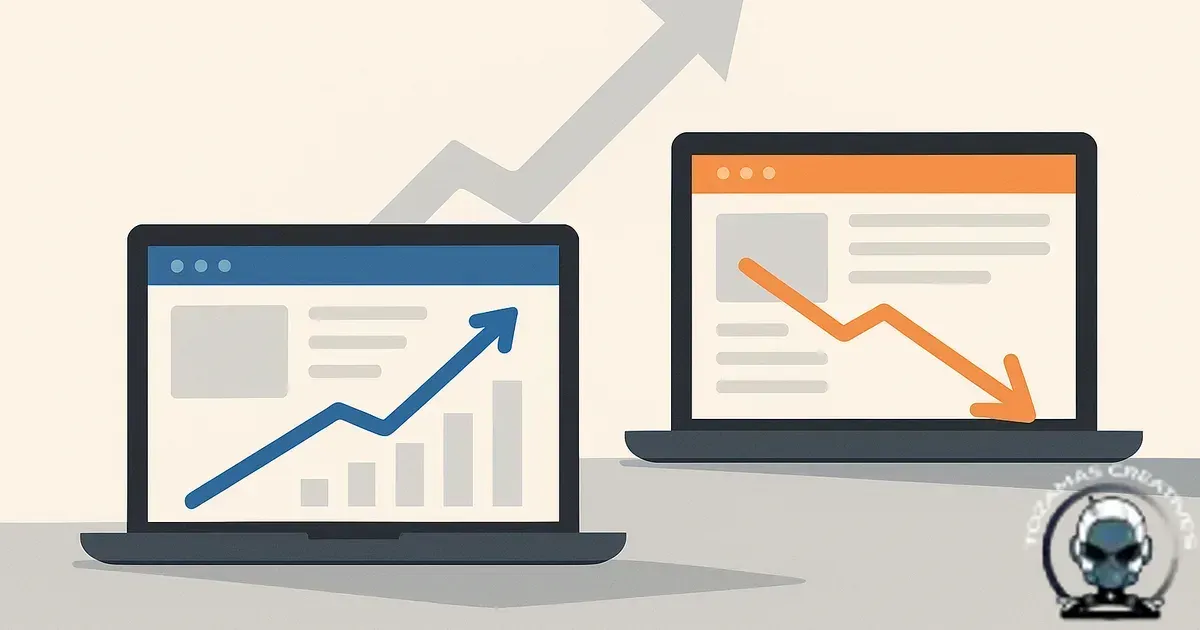
Growth isn’t a traffic spike. It’s a system that keeps paying you back.
When you look at why some websites keep climbing while others quietly taper off, it almost always comes back to compounding authority. Understanding authority compounding matters for any business serious about their online presence. The site steadily builds trust signals, internal clarity and content equity, so each new page is easier to rank and each update has more impact.
Most small business sites don’t stall because Google “changed the rules”. They stall because the site stops behaving like a coherent asset. Pages go live without a plan, older pages are left to decay, internal links drift away from what the business actually wants to sell, and the technical base slowly gets worse. From the outside it looks like bad luck. In reality, it’s neglect showing up in the numbers.
What authority compounding looks like in the real world
Compounding authority is when the work you did six months ago makes today’s work cheaper, faster and more predictable. In Search Console, you’ll notice impressions lifting across whole topic clusters, not just one “hero” page. Rankings hold even when competitors churn out more posts. New pages get indexed quickly and often land around page two or three straight away, rather than vanishing into the abyss.
That doesn’t come from pumping out volume. It comes from building a site where Google can confidently answer three things: what you do, who you do it for, and which pages are the best answers for specific intents.
Why some sites fade: they leak equity and create ambiguity
They build pages, not a map
According to recent studies, as of October 2026, 80% of users never scroll past the first page of search results, highlighting the critical need for authority compounding to ensure your site remains visible. Blog posts exist because someone had an idea. Service pages are there, but they’re thin and disconnected. Location pages are bolted on late. Case studies live in PDFs. Over time, the internal link graph stops communicating a clear story about priorities and expertise.
Google doesn’t reward you for simply “having pages”. It rewards clear relationships between pages. If your internal linking isn’t consistently reinforcing your most valuable topics and services, you’re asking external links and luck to do the heavy lifting.
If you want a practical way to think about this, read How Structured Content Silos Improve Search Authority for Small Businesses. It’s the difference between a library and a pile of books.
They treat on-page SEO as copy tweaks instead of intent alignment
Stalled sites often have “optimised” pages where the title tag and headings look fine, but the page doesn’t actually do the job the searcher came for. That gap shows up as weak engagement, short dwell time, low conversion, and then a slow slide as competitors publish pages that are simply more useful and more complete.
Authority compounding needs pages that earn their position. In practice, that usually means fewer, stronger pages that properly satisfy intent, backed by related content that removes friction and builds confidence.
They accumulate technical debt until crawling and rendering get expensive
Technical debt is what you get when quick fixes pile up: plugins stacked on plugins, page builders spitting out messy markup, bloated scripts, duplicated templates, and inconsistent URL patterns. On day one, none of it looks fatal. Give it a year or two and it becomes a constant drag on crawl efficiency, indexation quality and performance.
When Google has to work harder to interpret your pages, you lose the marginal gains that make compounding possible. Your strongest pages might still rank, but the site stops lifting as a whole. If this sounds familiar, What Is Technical Debt in Websites (And Why It Slows Growth)? breaks down the symptoms we see most often.
They change URLs and templates without protecting equity
Redesigns and platform migrations are a big reason sites “fade”. Not because redesigns are inherently bad, but because businesses underestimate how much authority is tied to specific URLs, internal link paths and content parity.
The usual culprits are redirect chains, missing redirects, changing URL structures “to tidy things up”, deleting sections that used to rank, or rebuilding pages with thinner copy because the new design wants more whitespace. Rankings don’t always fall off a cliff straight away. Often you get a three to eight week honeymoon, then a gradual decline as Google recalculates what your site is really about.
What keeps a site growing: reinforcing signals and reducing friction
A deliberate information architecture that mirrors how you sell
Sites that compound tend to have a service architecture that matches real buyer intent. Core money pages sit high in the structure, supported by deeper pages that cover specific use cases, comparisons, FAQs and proof. The internal linking isn’t accidental. It’s deliberately weighted toward what matters commercially.
This is where many small businesses get stuck: they publish educational content, but it never meaningfully strengthens the service pages. The blog becomes its own universe. Compounding happens when informational content feeds transactional pages through internal links, shared entities and consistent terminology.
Content that gets maintained, not just published
Evergreen pages only behave like assets if you keep them accurate. Growing sites routinely revisit pages that already have traction and improve them: update screenshots, add missing steps, clarify scope, strengthen internal links, tighten titles to match what’s actually ranking, and remove sections that muddy intent.
That maintenance work isn’t glamorous, but it’s where the compounding lives. A page sitting in positions 4 to 12 is often one solid update away from becoming a steady lead driver. If you never revisit those pages, you’re leaving growth on the table.
Clear topical focus, not “we do everything” positioning
Authority is much easier to build when your site has a strong centre of gravity. Businesses that try to rank for every adjacent service usually dilute their signals. You end up with a lot of pages that are loosely related, and none deep enough to be the best answer.
Topical focus doesn’t mean you can’t offer a broad range of services. It means you structure and prioritise your content so Google (and people) can immediately see what you’re known for. From there, you expand outward deliberately, keeping internal links and page hierarchy honest.
Trust signals that are actually machine-readable
Small businesses often have genuine credibility, but it’s buried in formats search engines struggle to interpret. If your proof lives in images, PDFs, or a carousel that isn’t properly crawlable, you’re not getting full value from it.
Growing sites tend to present trust in plain HTML: case studies with readable text, project summaries, named industries, clear service scope, and consistent business details. Where it makes sense, structured data (like Organisation, LocalBusiness, Service, FAQ) helps reduce ambiguity, but it can’t compensate for thin or inaccessible content.
The compounding loop: why momentum becomes hard to compete with
Once a site has a coherent structure, strong internal linking and pages that consistently satisfy intent, a feedback loop kicks in. Better rankings drive better engagement and more branded searches. Better engagement lifts conversion, which justifies investing more into the site. That investment improves content depth and technical quality. Competitors can copy a page, but they can’t quickly replicate the accumulated clarity across an entire site.
Stagnant sites never get that loop going. They lean on one or two pages, one campaign, or one channel. When it slows down, there’s nothing underneath to keep growth moving.
Where to look if your site has stalled
If impressions are steady but clicks are dropping, it’s often intent mismatch or a SERP shift your page no longer fits. If impressions are flat across the board, it’s usually information architecture, internal linking, or crawl/indexation problems. If you’re publishing and nothing indexes properly, look for technical debt, duplicated templates, and near-identical pages competing with each other.
The fix is rarely “write more blogs”. More often, it’s tightening the site map, improving the pages that already have signals, and making sure every new piece of content strengthens the authority you’re trying to build rather than just adding another URL.
What we do differently when building for growth
When we build or rebuild sites at TOZAMAS Creatives, we treat authority compounding as the target. That means locking in structure and internal linking before design, protecting existing equity during changes, and planning content around how the business actually wins work. Hosting and ongoing support matter as well, because compounding falls apart when a site is left unattended and technical debt quietly builds in the background.
Sources & Further Reading
- Google Search Central: Creating helpful, reliable, people-first content
- Google Search Central: Site structure and internal linking
- Google Search Central: Page experience (Core Web Vitals)
- Google Search Central: Move a site with URL changes
- Ahrefs: Internal links for SEO
- Google Search Central Blog – How Search algorithms work
- Moz – What is Domain Authority? How to Improve Your DA
- Search Engine Journal – The Importance of Internal Linking for SEO
- Google Search Central – Introduction to Site Structure

Build for Long-Term Growth
We build websites engineered to strengthen authority and visibility over time.
Explore Our ApproachComments
No comments yet. Be the first to join the conversation!



Leave a Comment
Your email address will not be published. Required fields are marked *