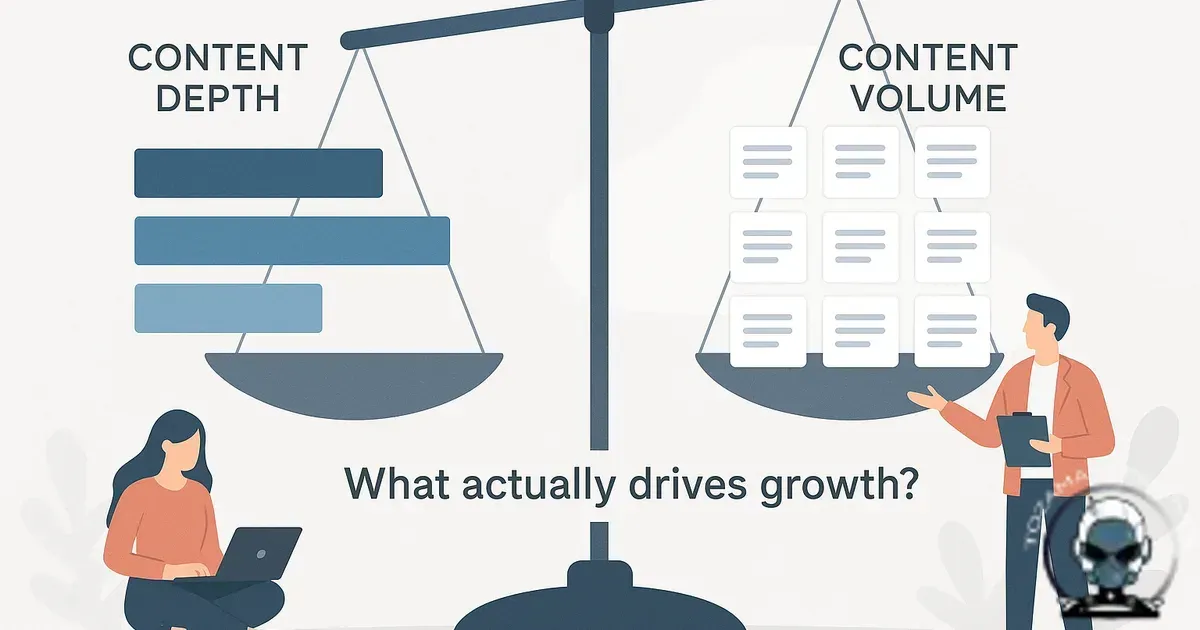
As of June 2026, content depth vs content volume is the trade off most small businesses ignore until the numbers make it uncomfortable. You can publish constantly and still go nowhere. Growth usually shows up when you build a foundation of pages machines can confidently cite and humans can actually use.
Why volume feels like progress (and why it often isn’t)
Volume feels good because it’s visible. You can point to a packed calendar, a queue of posts, a steady stream of “activity”. The catch is that activity doesn’t automatically create discoverability. If each piece is thin, repetitive, or disconnected from a clear topic set, you’re feeding platforms content instead of building your own infrastructure.
In practice, high volume publishing creates three predictable problems. First, it fragments intent. You end up with ten posts that half answer a question instead of one asset that resolves it end to end. Second, it weakens internal linking and topical signals, so your site reads like a scrapbook rather than a system. Third, it creates maintenance debt. Every short post is another URL that can go stale, clash with a newer page, or quietly cannibalise attention.
Depth is not “longer”. It’s tighter alignment with intent
Depth gets mistaken for word count. Real depth is algorithmic alignment plus technical integrity. It’s a page that helps a user complete a task and gives a machine stable meaning it can extract.
When we audit underperforming content, the issue is rarely “too short”. It’s missing structure and missing decisions. The page won’t commit to a primary intent, terms shift halfway through, evidence is vague, and supporting pages aren’t connected in a way that proves topical authority.
Depth looks like clear scope, strong information hierarchy, precise language, and proof you’ve actually done the work. For service businesses, that usually means constraints, trade offs, real examples, and the operational steps people trip over. That’s high signal for both AI systems and humans.
What drives growth now: citations, not noise
Traditional search could reward breadth over time because enough pages eventually picked up enough long tail queries. That still happens, but the bar for “worth showing” has moved. AI Overviews and AI assisted discovery compress the journey. Users get an answer faster, which means fewer clicks go to “me too” pages.
If you want consistent growth, you need content that earns citations. Not just backlinks, but references in AI generated answers, excerpts, and summaries. Those systems look for clarity, consistency, and corroboration. Thin pages that recycle generic advice don’t hold up because there’s nothing solid to cite.
This is also where brand trust becomes measurable. A deep page reduces pogo sticking, lifts engagement quality, and attracts the kind of links and mentions that compound. Volume can spike impressions. Depth builds an asset.
Topical authority is built like a knowledge base, not a feed
The fastest way to build topical authority is to choose a small set of problems you want to own, then publish a connected cluster that covers them properly. That cluster needs a centre of gravity. Usually it’s a definitive guide or a “hub” page, supported by narrower pages that handle sub intents.
Most businesses do the opposite. They publish whatever came up in a client call that week, then wonder why nothing sticks. The answer isn’t to post more. The answer is to design the ecosystem so each page has a job, and every job supports the same outcomes. If you want a practical way to think about that system-level approach, start with a business growth system mindset and work backwards into content decisions.
The depth stack we look for in high-performing pages
Depth is easier to build when you treat content like product documentation. Start with the primary intent and lock it in. Then add the layers that make the page defensible.
We look for, a clear definition of the problem, the decision criteria people actually use, the constraints that change the answer, budget, compliance, timelines, tech stack, and the steps that turn advice into action. Then we tighten it with internal links to supporting pages, consistent terminology, and on-page structure machines can parse.
That last part matters more than most people expect. Headings that mirror intent, tables or comparisons where appropriate, and clean schema markup, when it genuinely fits, improve extractability. This is the unglamorous side of discoverability, but it’s where technical integrity lives.
When volume helps (and when it’s just content debt)
Volume helps when you already have depth. With a solid foundation of evergreen pages, higher frequency publishing can widen the net and feed distribution channels without undermining your core signals. Treat it as amplification, not strategy.
Volume becomes content debt when it’s used to paper over weak pages, unclear positioning, or a site that isn’t built to convert. If your funnel is leaky, more traffic just means more wasted attention. This is why we tie content planning to conversion pathways and site architecture, not just keywords and calendars. If you’re seeing plenty of sessions but not much movement in enquiries, map your conversion pathways first before you publish another batch of posts.
Thin content isn’t just a quality issue. It’s a systems issue
Thin content usually comes from one of three root causes. The business doesn’t have a defined point of view, the writer doesn’t have access to real operational detail, or the website isn’t treated as infrastructure. Any of those produces generic pages because there’s nothing specific to anchor to.
Fixing thin content usually means fixing inputs. Pull the subject matter out of the business and into a usable format. Capture sales calls, support tickets, objections, and the real reasons deals stall. That’s where the high signal content lives. Then build pages that answer those points cleanly and consistently.
If you’re publishing regularly and it still feels like you’re treading water, look hard at the cost of that output. This breakdown of what an underperforming website actually costs applies just as much to underperforming content. Time is a budget, even when it’s “just a blog post”.
A practical way to choose: depth first planning that still ships
Depth first doesn’t mean disappearing for three months to write a masterpiece. It means building a small number of pages that can carry weight, then expanding around them deliberately.
If you’re choosing between publishing four light posts or one page that becomes the reference your prospects send around internally, pick the asset. Then reuse it properly. Break it into smaller distribution pieces, but keep the canonical page as the source of truth. That’s how you avoid contradictions and keep your topical signals tight.
On the measurement side, stop treating pageviews as the win. Track assisted conversions, quality of enquiries, time to decision, and whether the page reduces repetitive sales conversations. Deep content can look “slow” in week one and “inevitable” by month three because it compounds.
What actually drives growth
Growth comes from content that behaves like infrastructure. It earns trust, it’s easy to cite, and it connects to the rest of your site in a way that makes your expertise legible to machines. Volume has a place, but only after you’ve built the foundation that makes volume worth amplifying.
Sources & Further Reading

Want a depth first content system that compounds?
We’ll map your topic ecosystem and build pages that earn citations and enquiries.
Get in TouchComments
No comments yet. Be the first to join the conversation!



Leave a Comment
Your email address will not be published. Required fields are marked *