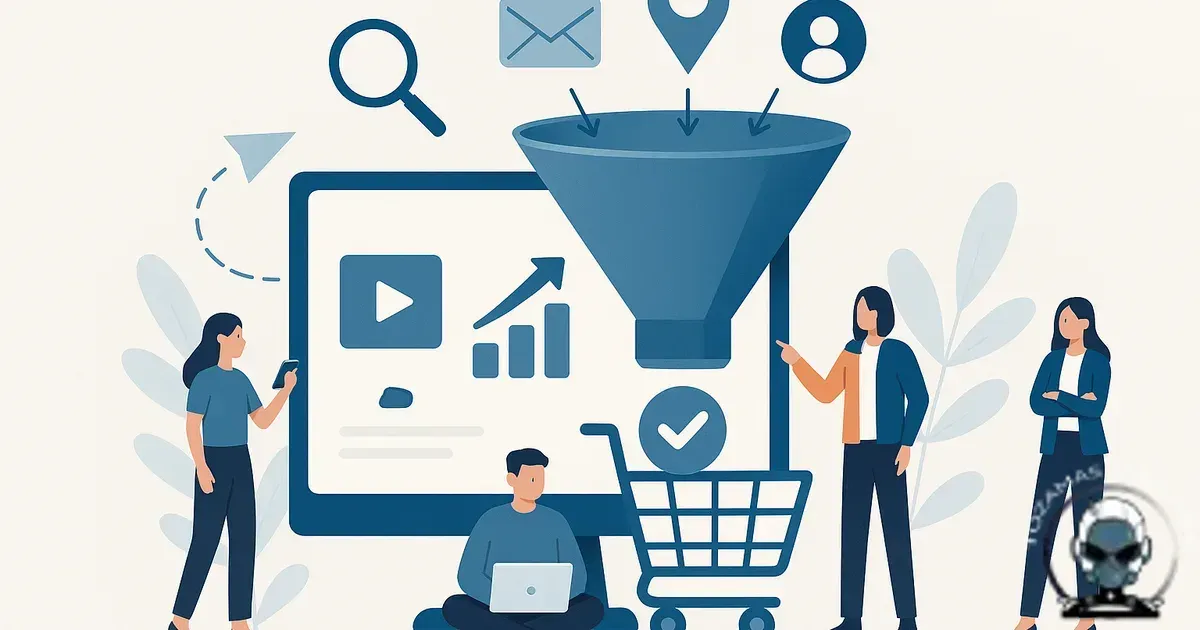
A conversion pathway is an engineered route that guides potential customers from initial interest to purchase. It is crucial because it aligns with user intent, ensuring that every step of the journey reduces uncertainty and builds trust, ultimately leading to higher conversion rates.
Traffic isn’t the problem. Pathways are.
Conversion pathways are the engineered routes that move a real person from “I’m browsing” to “I’m buying”. When a site gets traffic but not customers, it’s rarely a copy issue. It’s usually a breakdown in Technical Integrity, the journey doesn’t match intent, the calls to action don’t line up with decision stage, and the tracking can’t show you where people actually drop off.
Most small businesses don’t need more channels. They need Algorithmic Alignment between what the visitor came for, what the page proves, and what the next step asks them to do.
Start with intent, not pages
A conversion pathway isn’t “Home → About → Contact”. That’s navigation. A pathway is intent driven, and each step should reduce uncertainty.
In practice, three intent bands show up in analytics and enquiries, even when the offer is complex, problem aware, they know the pain, solution aware, they’re comparing approaches, and vendor aware, they’re choosing a provider. If you send problem aware traffic straight to a “Book a Call” CTA, you’re asking for commitment before trust exists. If you send vendor aware traffic to a vague explainer page, you slow them down and they’ll keep shopping.
This is where a lot of funnels fail. They’re built like brochures, not decision systems. If you want a deeper view on building the site as connected Infrastructure, not isolated pages, read Designing a Website Ecosystem (Not Just Pages): Infrastructure for Discoverability.
Map one pathway per acquisition source
Not all traffic should land on the same page, even if the offer is identical. A Google Search visitor arrives with a specific query. A Meta click arrives with interrupted attention. A referral from a partner arrives with borrowed trust. Treat them the same and you end up with “good traffic” that bounces.
For each meaningful source, you want a primary landing page that matches the promise that brought them in, then a single logical next step. That next step might be a quote form, a booking, a product page, a lead magnet, or a “see pricing” page, but it needs to be consistent. When every page has three competing CTAs, your site turns into a choose your own adventure with no ending.
Design CTAs as a sequence, not a button
A CTA isn’t a colour choice. It’s a commitment request. The bigger the request, the more proof and clarity you need before it.
On high intent pages, the primary CTA should remove friction, not introduce it. “Call now” works when the visitor already believes you’re the right provider and they need immediacy. “Book a consult” works when the buyer expects a considered sales process. “Get a fixed price quote” works when you can genuinely scope quickly and you want to reduce back-and-forth.
On mid intent pages, the CTA should create momentum without demanding too much. Think “See examples”, “Compare packages”, “Check availability”, “Get the checklist”. These are micro commitments that keep the pathway moving while you build trust.
On low intent pages, the job is Discoverability and education, not closing. This is where you build citations and topical authority over time, but you still need a next step that fits the visitor’s headspace.
Remove “decision friction” before you touch the copy
When conversions are low, people usually rewrite headlines first. We check friction points first, because they’re measurable and they quietly break pathways.
Common friction patterns we see on service sites include slow mobile pages, confusing form fields, and vague service descriptions that force the user to guess what you actually do. Another big one is hidden constraints. If you only service Brisbane, say it early. If your minimum job size is $2,000, don’t wait until the call to reveal it. Surprises don’t convert, they create resentment and no shows.
Friction also shows up as missing proof. Case studies, before and after examples, process explanations, and clear inclusions aren’t “nice to have”. They’re conversion Infrastructure. If you’re relying on a Google Business Profile to do the heavy lifting while your website stays vague, you’re leaving money on the table. The practical reasons are covered in Why Google Business Profiles Alone Are Not Enough.
Build a funnel that matches how Australians actually buy
For many Australian small businesses, the sale isn’t purely online. The website’s role is to qualify, pre sell, and route the right people into the right conversation. That means your funnel needs to separate buyers who are ready from browsers who are early.
If you sell a high trust service, a single “Contact us” form is usually too blunt. You want at least two pathways, one for high intent buyers, quote, booking, call, and one for evaluators, pricing explainer, examples, capability statement, email nurture. This isn’t about making it complicated. It’s about respecting intent so your sales time goes to the right leads.
If you’re running paid traffic, this matters even more. Paid clicks amplify whatever’s broken. If the pathway is unclear, you’re just paying to find out faster.
Measure the pathway, not just the outcome
If your only metric is “leads this month”, you can’t see where the pathway leaks. You need event level measurement that shows whether people are progressing or stalling.
At minimum, track the steps that represent commitment: click to call, form starts, form submits, booking completions, pricing page views, PDF downloads, and key scroll depth on long pages. In GA4, configure these as events with clean naming so you can segment by source, landing page, and device.
Then you can answer the questions that actually move revenue. Are paid visitors hitting the page and leaving, or are they moving but failing at the form? Are mobile users dropping off at the same step every time? Are certain landing pages generating “leads” that never close because the pathway attracts the wrong intent?
When data integrity is poor, decisions default to gut feel and anecdotes. That’s how businesses get stuck in a loop of redesigns and new campaigns without fixing the Foundation.
Common pathway failures (and what we change first)
The biggest failure is mismatched intent. The page answers a different question to the one the visitor is asking. The fix is usually structural, build a landing page that mirrors the query and removes the next uncertainty, not a generic service page that tries to please everyone.
The second failure is CTA noise. Too many options, too early. We’ll usually force a primary action per page, then support it with secondary actions that don’t compete.
The third failure is funnel gaps. People click “Get a quote” and land on a dead end form with no context, no inclusions, and no timeframe. We add pre-qualification, expectations, and proof around that moment, because that’s where commitment actually happens.
The fourth failure is a lack of handoff logic. If someone downloads a guide or requests pricing, what happens next? If your CRM, email, and internal process aren’t connected, the pathway ends the second the form submits. That’s not a marketing issue. That’s missing Infrastructure.
Build pathways that compound, not campaigns that reset
When conversion pathways are intentional, marketing stops feeling like constant reinvention. Each new piece of content, each new ad, each new service page plugs into the same decision system. That’s a stronger Foundation. It also makes your site easier for machines to interpret, which improves Discoverability and citations over time.
If you’re scaling offers or adding locations, the pathway design has to scale as well. Otherwise you end up with a maze of pages and inconsistent CTAs that only the person who built it understands. The practical approach to that is covered in Building a Website That Scales With Your Business.
Sources & Further Reading

Need a conversion pathway audit?
We’ll map your user journeys, fix leakage points, and tighten tracking so traffic turns into customers.
Get in TouchComments
No comments yet. Be the first to join the conversation!

Leave a Comment
Your email address will not be published. Required fields are marked *