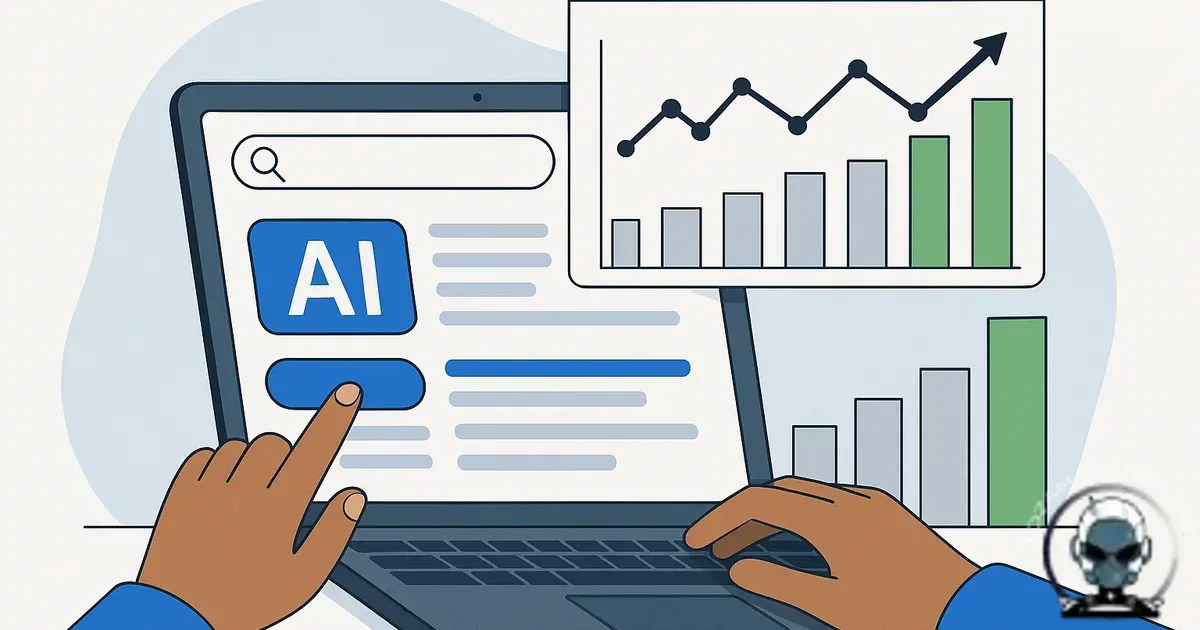
AI search is rewriting the click
AI search results are changing website traffic in a way most small businesses will feel before they can properly name it: more impressions, fewer clicks, and a widening gap between “we rank” and “we get enquiries”. Google’s AI Overviews (and similar features in Bing and elsewhere) are designed to answer the question right there on the results page. The SERP isn’t just a list of links anymore. It’s becoming the destination.
You notice it fastest on informational searches. If someone Googles “how much does it cost to epoxy a garage floor” or “best time to prune citrus trees in Queensland”, an AI summary can cover the basics without anyone visiting your site. For marketers, that forces a rethink of what “SEO success” actually looks like. For business owners, it changes where the next lead really comes from.
What’s actually happening on the results page
“Zero click” behaviour isn’t new. Featured snippets, knowledge panels, maps, and “People also ask” have been eating clicks for years. AI summaries take it further by stitching an answer together from multiple sources, then dropping in a few citations. Users get the gist in seconds and only click when they want depth, reassurance, pricing, local availability, or a clear next step.
In analytics, two things tend to show up quickly. First, Search Console impressions often climb because your page is being pulled into the answer set, or because the query expands into more variants. Second, click through rate drops because the SERP is doing more of the work. If you’re still reporting “rankings” without breaking down CTR by query type, you’re missing the part that matters.
Core AI Technologies Driving Search Result Evolution
Understanding the foundation of AI search requires a grasp of natural language processing (NLP) and machine learning, the core technologies powering modern search engines like Google and Bing. NLP enables platforms such as Google's BERT and OpenAI's GPT models to parse and interpret human language more contextually, moving beyond simple keyword matching. According to Google Search Central documentation (2023), BERT helps the algorithm understand nuances in user queries, improving the relevance of AI generated summaries directly on the search engine results page (SERP).
Machine learning frameworks underpin the continuous refinement of search algorithms. Google’s RankBrain, for example, uses historical search data and user interaction signals collected via Google Analytics 4 to dynamically improve query understanding and result ranking. This algorithmic alignment ensures that AI generated overviews and citations reflect authoritative, up to date information sourced from trusted domains that comply with W3C’s structured data specification.
Furthermore, schema markup using JSON-LD format is essential infrastructure for signalling content semantics to AI search systems. Schema.org, maintained by a consortium including Google, Microsoft, and Yahoo, standardises these structured data formats, allowing AI to extract precise entity relationships and improve discoverability. As of June 2024, Bing's Webmaster Guidelines confirm that well implemented structured data increases the likelihood of content inclusion in AI driven answer boxes and knowledge panels.
These technologies collectively form the technical integrity of AI search infrastructure, demanding business websites adopt robust semantic and operational structures. For a detailed approach to building this foundation, see our Complete Guide to Technical SEO for Business Websites, which covers implementation strategies for schema, internal linking, and performance optimisation aligned with AI driven discoverability.
Why some pages lose traffic and others gain it
AI summaries don’t treat all content equally. Pages that “answer the question” in a generic way are the easiest to summarise and the least likely to earn a click. If your page is basically what the AI can produce in three sentences, you’ve effectively taught Google to keep the user on Google.
The pages that keep winning usually have at least one advantage, they’re specific to a location, a product range, a process, a compliance requirement, a price structure, or a real world constraint. They include original detail that isn’t easily inferred from other sources. And they make it obvious, both to crawlers and humans, what the page is, who it’s for, and what to do next.
This is where a “strong structured site” matters. Not because structure is trendy, but because AI systems and classic ranking systems both depend on clear entity signals, internal relationships, and unambiguous intent. If your site is a pile of disconnected posts, you’ll get summarised. If it reads like a well-organised reference and service catalogue, you’re far more likely to be cited and clicked.
AI Overviews and the new funnel shape
Small businesses often assume the funnel starts on their website. Increasingly, it starts on the SERP, and your site becomes step two. AI Overviews compress the top of funnel. People arrive later in their decision making, which is great if your site is built to convert, and a problem if you rely on slow “educate them over time” content journeys.
In practice, you’ll see fewer visits to broad explainer pages, and relatively more value in pages that support action, service pages with clear inclusions, location pages that match how people actually search, comparison pages that spell out trade offs, and “how it works” pages that reduce perceived risk. If your conversion path is vague, the traffic you do get will bounce harder because the user is already impatient by the time they click.
What “structured” means in 2026, not 2016
When people hear “structured site”, they picture menus and tidy URLs. That’s the easy bit. The structure that matters now is semantic and operational.
Semantic structure: make the site legible to machines
Start with clean information architecture, each core service has a canonical page, supporting pages cluster underneath it, and internal links reflect real relationships (not “related posts” widgets). Use headings that match intent, not clever copy. Keep page purpose singular. When a page tries to rank for five different intents, AI systems won’t cite it with confidence and humans won’t trust it either.
Schema markup still matters, but only when it mirrors reality. Local Business, Service, Product, FAQ (where appropriate), and Review schema can help clarify what you offer and where. It won’t save thin content, and it won’t fix a messy site. Think of schema as labelling a well run warehouse, not trying to organise stock by dumping it in the carpark.
Operational structure: make the site easy to maintain and expand
AI driven SERPs can reward freshness in some niches, but they reward consistency and coverage even more. If updating a service page takes three people and a developer, it won’t happen. If adding a new location page breaks navigation, you’ll avoid doing it. The businesses that keep gaining organic share are the ones with a site setup that supports ongoing improvements without drama. We’ve written more on the underlying approach in Why Businesses That Invest in Proper Website Infrastructure Win Long-Term.
How to respond without chasing every AI trend
The goal isn’t to “optimise for AI” as a vague strategy. The goal is to earn the click that still matters, and to be the kind of source AI systems are comfortable citing.
Write for the part the AI can’t safely compress
Generic definitions are now commodity content. What still holds value is decision support: constraints, edge cases, local conditions, pricing drivers, timelines, failure modes, and what to do when something goes wrong. If you’re a service business, publish the explanations your best salesperson gives on the phone. If you’re eCommerce, publish the trade offs that reduce returns and hesitation.
That doesn’t mean every page needs to be long. It means every page needs to earn its keep in a way a summary can’t replace. A tight page with a clear scope, a table of inclusions, and a transparent process often beats a 2,000 word “ultimate guide”.
Build pages that satisfy “next step” intent
AI Overviews handle “what is” and “how to” queries well. They’re weaker at “who should I hire”, “what does it cost here”, “can you do it by Friday”, and “show me examples like mine”. Your site should meet that intent head on. Case studies with real constraints, service pages with clear boundaries, and galleries with context (not just pretty photos) are harder to summarise and much easier to trust.
Use internal linking like a map, not a suggestion
Internal links are one of the few levers you fully control. They tell search engines which pages are primary, which are supporting, and how topics connect. When we audit sites losing organic traffic to zero click results, the pattern is usually weak clustering: plenty of articles, no centre of gravity. If you want a practical framing for structure and conversion, How Proper Website Structure Improves Lead Generation is a solid reference point.
Measure the right thing: query groups, not vanity averages
Average CTR across the whole site is becoming less and less useful. Break Search Console data into groups: informational queries, commercial investigation queries, and transactional/local queries. Track what AI Overviews is doing to each group. If informational CTR drops but enquiry volume holds, you may be fine. If commercial investigation CTR drops, you’ve got a positioning and page quality issue, not just a traffic issue.
Adapting SEO Strategy for the AI Search Era
Businesses must recalibrate their SEO approach to align with evolving AI search dynamics that prioritise algorithmic alignment and structured discoverability. According to Google's Search Central documentation (2023), optimising for AI driven answer engines involves integrating Schema.org structured data using JSON-LD to enhance content clarity and citation strength. Platforms like Google Analytics 4 enable granular tracking of query groups and user engagement beyond traditional click metrics, providing actionable insights to refine content strategy. At TOZAMAS Creatives, our Digital Strategy Consultants leverage these tools to build resilient digital foundations that bridge human intent and machine discoverability.
Operationally, tools such as Screaming Frog and SEMrush support ongoing audits of technical integrity by identifying crawl issues and schema implementation gaps that could hinder AI comprehension. As documented by the W3C's structured data specification (2021), adherence to ARIA and accessibility standards further future proofs infrastructure by ensuring content is machine legible and human accessible, which AI models increasingly factor into their relevance assessments. Our AI Search Optimization Specialists at TOZAMAS Creatives integrate these standards to maintain algorithmic alignment.
In practice, businesses should leverage HubSpot or Salesforce CRM data to correlate AI search driven lead signals with customer journeys, closing the loop between discoverability and conversion. The Australian Competition and Consumer Commission (ACCC) emphasises transparent data practices to maintain trust signals, which are critical as AI engines weigh domain authority and citation provenance. By embedding these technical and operational adjustments, firms build resilient digital foundations that sustain discoverability in an AI-first search landscape.
Integrating AI Driven SEO and Organic Traffic Strategies
Building high performance digital foundations requires incorporating AI driven SEO principles to maintain technical integrity and future proof discoverability. Platforms like Google's Search Central documentation and Bing Webmaster Guidelines emphasise algorithmic alignment through structured data and semantic HTML, enabling AI algorithms to accurately interpret content intent. Leveraging JSON-LD schema markup, as standardised by the W3C in their structured data specification, ensures that your website’s entity signals are machine readable, enhancing citation strength in AI-generated search overviews.
Organic traffic strategies must now evolve beyond traditional keyword metrics to focus on query intent groups and AI search result features. Google Analytics 4, integrated with Google Tag Manager, provides granular insights into user engagement with AI driven result formats, allowing data driven adjustments to content architecture. According to Google's 2023 Search Algorithm Update notes, continuous monitoring of algorithmic shifts and adapting website operational structure to support AI content summarisation are essential for maintaining discoverability.
Technical platforms like HubSpot and Salesforce CRM play pivotal roles in capturing and nurturing leads generated through AI enhanced search experiences, linking organic traffic directly to business outcomes. Additionally, content management systems such as WordPress and headless CMS frameworks like Strapi facilitate the implementation of modular content blocks aligned with AI search citation requirements. As documented by Moz’s 2024 SEO Industry Report, businesses utilising these integrated infrastructures achieve higher technical integrity and sustained organic traffic growth. At TOZAMAS Creatives, our AI Search Optimization Specialists ensure these platforms are optimally configured to support ongoing discoverability.
For practical guidance on adapting your website infrastructure to AI driven discoverability demands, refer to our Complete Guide to Technical SEO for Business Websites, which details the necessary architecture and structured data practices to future-proof your digital assets efficiently.
Strategic Adjustments for SEO in the AI Search Landscape
Businesses must pivot from traditional SEO tactics to a technically robust approach that aligns with AI driven discoverability metrics. Google Search Central documentation (2023) emphasises the importance of implementing Schema.org structured data using JSON-LD format to enhance the clarity of content entities for AI algorithms. Platforms like Bing Webmaster Tools similarly recommend leveraging semantic markup to improve algorithmic alignment, ensuring AI overviews cite your authoritative pages accurately. This foundational infrastructure supports greater visibility on AI powered results pages beyond mere keyword presence.
Operationally, maintaining technical integrity by using content management systems such as WordPress combined with plugins like Yoast SEO or Rank Math allows for ongoing schema updates aligned with evolving AI search standards. According to W3C’s structured data specification (2024), consistent use of well formed schema markup reduces ambiguity for natural language processing models including Google’s BERT and OpenAI’s GPT, which underpin AI search results. Additionally, integrating Google Analytics 4 and Google Search Console data helps monitor query groups for discoverability shifts, aligning measurement with AI’s nuanced intent understanding rather than legacy ranking signals.
Actionable insights include building content that addresses “next step” user intents, such as decision making, purchase facilitation, or local availability, supported by clear internal linking structures. HubSpot’s CMS Hub and Salesforce Marketing Cloud provide tools to map and optimise these internal pathways, reinforcing site architecture and citation strength within AI result compilations. This system first philosophy ensures your digital infrastructure is resilient to AI search evolution, preserving long term discoverability and data integrity. At TOZAMAS Creatives, our AI Search Optimization Specialists and Digital Strategy Consultants collaborate to implement these strategic adjustments effectively.
The upside most businesses miss
AI summaries can cut out junk traffic. If your site used to attract people who were never going to buy, losing some volume isn’t a disaster. What you want is fewer, better visits. The businesses doing well right now are treating organic search less like a blog channel and more like a product, clear pages, clear offers, clear proof, and a site that’s easy to expand as the business evolves.
AI search results are changing website traffic, but they’re not killing websites. They’re punishing vague content and rewarding sites that are structured, specific, and built around real decision making. Make it easy for a machine to understand what you do, and easy for a human to take the next step, and you still win the click when it counts.
Sources & Further Reading

Need help protecting your organic traffic?
We can audit your site structure and pages, then prioritise changes that keep enquiries coming.
Get in TouchComments
No comments yet. Be the first to join the conversation!


Leave a Comment
Your email address will not be published. Required fields are marked *