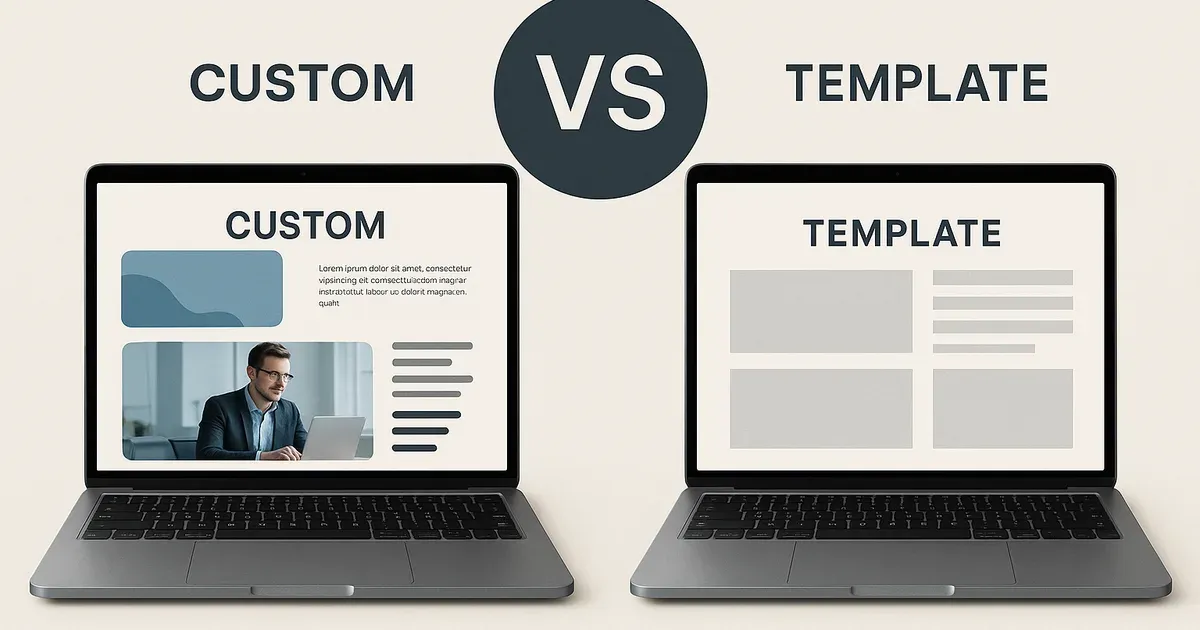
Custom vs template websites isn’t a design debate, it’s an infrastructure decision. The site you choose becomes the foundation for discoverability, conversion pathways, analytics, integrations, and how easily you can change course when the market shifts.
Templates are products. Custom sites are systems.
A template website is a pre built product with assumptions baked in. Layouts, content blocks, navigation patterns, and often the underlying theme code are set up to suit the widest range of businesses. That’s why templates feel fast and cheap upfront, you’re adopting something that already exists.
A custom website is a system engineered around your business model, your sales process, and your data. The “custom” part isn’t the visual layer. It’s the information architecture, the component logic, the content model, and the technical integrity of how everything connects.
You’ll get away with a template if the business is stable, the offer is simple, and marketing is light touch. But if you need to compound authority, support multiple services, target multiple locations, or integrate with tools that actually matter, templates can start to feel like you’re building a shed on top of a caravan.
Cost isn’t the price tag. It’s the change budget.
Most businesses compare custom vs template websites using the initial invoice. Fair enough, but that’s not where the real cost shows up. The real cost is what it takes to change things later without breaking the site, the tracking, or the conversion flow.
According to a recent survey by HubSpot, 82% of marketers report that content marketing has enhanced their engagement significantly, demonstrating the growing importance of tailored strategies in today's digital landscape. Templates tend to create a “change tax”. You add a plugin to do one thing, another plugin to patch the conflict the first one caused, and suddenly routine updates become risky. Then updates get avoided, which is how performance and security quietly slide. You can coast for a while, until you can’t.
Custom builds aren’t automatically clean either. A custom site with no standards, no documentation, and no deployment discipline is just bespoke chaos. The difference is that a proper custom build gives you control over the moving parts, instead of relying on a third party theme developer to keep up.
Discoverability is structural, not cosmetic
Search has shifted from “ten blue links” to machine mediated answers. That makes algorithmic alignment more important than small copy tweaks. Machines don’t understand your business because the homepage looks modern. They understand it because the site is structured, consistent, and easy to parse.
Templates often nudge you into shallow structure, a handful of pages, a generic services page, and a blog that isn’t connected to anything. It can look fine, but it’s hard to build meaningful topical clusters, internal linking pathways, and clear entity signals.
Custom builds make it easier to implement a content model that matches what you actually sell. Separate service lines, location logic, case studies tied to specific services, FAQs mapped to real customer questions, and schema that reflects your business accurately. If you want the deeper version of this, our published piece Why AI Makes Strong Website Architecture More Important Than Ever covers what’s changing and why the foundation matters.
Scalability is usually a content and data problem
When a template site “doesn’t scale”, it’s rarely because the server can’t handle traffic. It’s because the site can’t handle complexity, more services, more locations, more lead sources, more landing pages, more tracking requirements, more integrations.
This is where template constraints show up in day to day work. You can’t create new page types without hacking the theme. You can’t keep layouts consistent without manual effort. You can’t add structured fields without a plugin that changes the editor experience. You can’t run clean experiments because every change is tangled up with theme behaviour.
A custom build should treat content like data. Service pages shouldn’t be one off snowflakes, they should be instances of a repeatable model with consistent headings, modules, internal links, and schema support. That’s how you scale without the site becoming a maintenance nightmare. We’re writing more on this in Building a Website That Scales With Your Business.
Flexibility is about constraints you can live with
Some constraints are useful. A template can force discipline if you’re prone to scope creep. It can stop you inventing a new layout for every page. It can keep the build tight.
The problem is when the constraints block business critical moves. Common examples we see in SMEs include adding a second or third service line, building out service area pages properly, moving from “contact us” to multi step lead qualification, or integrating with a CRM without duct taping forms together.
When you hit those moments, the question isn’t “can the template do it?” It’s “can it do it cleanly, without compromising performance, analytics, and future changes?” That’s technical integrity in practice.
Performance and reliability: templates fail in predictable ways
Templates often ship with features you don’t use, but still pay for in load time. Heavy theme frameworks, bundled sliders, multiple icon libraries, and scripts that run on every page “just in case”. Then plugins add more scripts, more CSS, more database queries. The site still loads, but the experience becomes inconsistent across devices and networks, and that directly affects conversion rates.
Custom doesn’t automatically mean fast. Speed comes from decisions, lean component design, sensible image handling, script discipline, and hosting that matches the workload. The advantage of custom is you can make those decisions deliberately instead of inheriting them.
Ownership: who controls the foundation?
With templates, you’re often dependent on the theme vendor’s roadmap. If they stop updating, you either freeze your stack or rebuild. If they push an update that changes core behaviour, you test and hope. Some ecosystems are better than others, but the dependency is real.
With custom builds, the dependency shifts to whoever built it. That’s why documentation, code standards, and a clear handover matter. If a developer can’t explain how the site is structured, how deployments happen, and how tracking is implemented, it’s not a system. It’s a black box.
How to decide without getting stuck in a false choice
If your goal is a credible online presence you won’t touch much for the next couple of years, a well chosen template can be the right call. The key is picking a template that supports clean structure and avoids plugin sprawl, not one that just ships with lots of layouts.
If your goal is growth, the decision should be driven by what you need the website to do as infrastructure. Can you create repeatable landing pages without breaking design consistency? Can you measure the full conversion pathway end to end? Can you add content in a way that improves discoverability and earns citations over time? Can you integrate with your sales stack cleanly?
When those answers matter, custom tends to be cheaper in the only way that counts, it reduces the cost of change. If you’re weighing options for a rebuild or a first proper site, Conversion Pathways: How to Turn Traffic Into Customers is worth reading alongside this, because most template regret starts when the site can’t support the sales process you actually need.
Sources & Further Reading

Need a website foundation you can actually grow on?
We’ll map the right build path for your goals and manage the infrastructure end to end.
Get in TouchComments
No comments yet. Be the first to join the conversation!



Leave a Comment
Your email address will not be published. Required fields are marked *