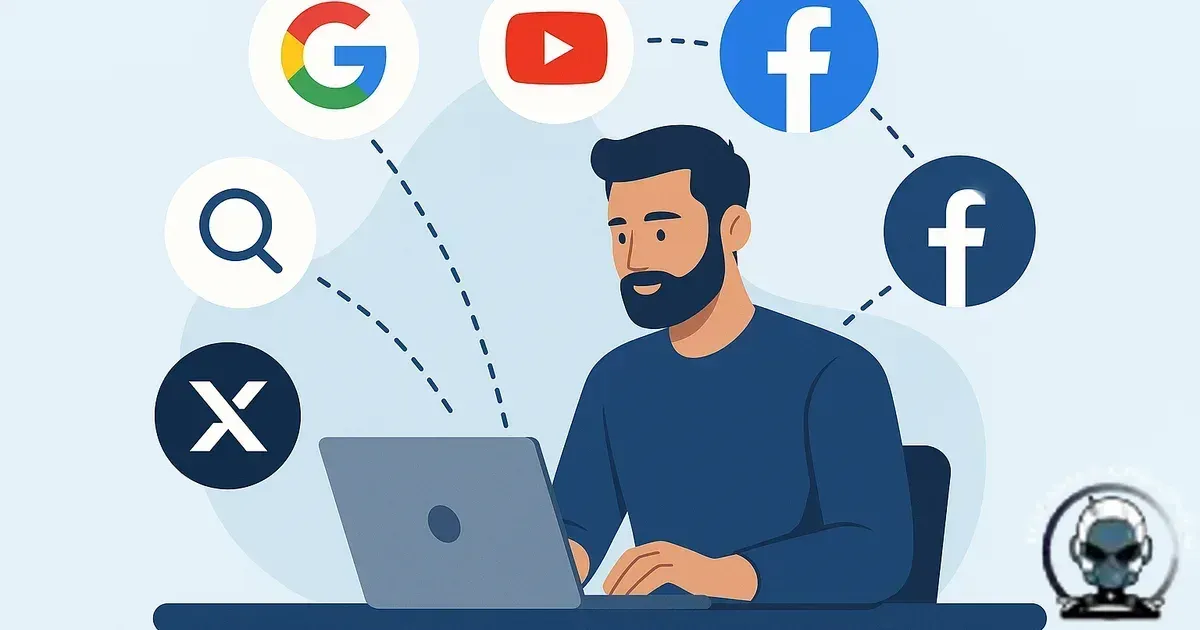
Beyond Google: why a single-channel strategy plateaus
You build a multi platform distribution engine when you stop treating Google (or any single platform) as “the strategy” and start treating it as one input into a wider system, one that keeps generating demand even when algorithms change, ad costs jump, or audience behaviour shifts.
Most small businesses I see stuck under the same revenue ceiling share the same weakness: their visibility is concentrated in one or two places. Usually it’s organic search plus one social channel, sometimes with paid search bolted on. It works, until it doesn’t. One core update, a competitor with deeper pockets, an account restriction, or a rough season of higher CPCs and the pipeline suddenly looks very thin.
The answer isn’t “do more marketing”. It’s building distribution the way you’d build infrastructure: redundancy, feedback loops, and compounding returns. That means content and offers designed to move across ecosystems, plus measurement that tells you which ecosystems are actually producing customers, not just impressions.
Search and social are not the problem. Dependence is.
Google is still the highest intent channel for most service businesses. Social still matters for awareness, credibility, and building retargeting pools. The issue is when your business assumes those two will keep behaving the way they did last year.
Search is getting squeezed at the top of the page. Paid units, local packs, AI summaries, and aggregator sites can steal clicks even when your rankings look “fine”. Social brings its own reality: volatile reach, short content half life, and audiences that aren’t arriving with intent. Both channels can work well, but neither is a stable foundation on its own.
When you spread distribution, you’re doing more than hedging risk, you’re creating more entry points into the same buying journey. A prospect might first find you on YouTube, then Google you a week later, then click an email offer, then convert after a remarketing touch. If you only look at last click, you’ll consistently underinvest in the channels that created the demand in the first place.
What “multi-platform” really means in practice
This isn’t about being everywhere. It’s about choosing ecosystems that suit your category, then building repeatable publishing and capture mechanics inside each one.
Platforms behave differently because the intent model is different. Google is demand capture. YouTube and podcasts are demand creation with long shelf life. LinkedIn can do both, depending on the niche. Marketplaces and directories are often demand interception. Email and SMS are owned distribution. Partnerships are borrowed distribution. Multi platform works when each part has a job, and each part feeds the next step.
Where most businesses come unstuck is copy paste. They post the same thing everywhere, get soft results, and decide the platform “doesn’t work”. More often, the platform is fine, the packaging isn’t. Format, framing, and call to action have to match how that ecosystem actually behaves.
The compounding effect: why ecosystems beat campaigns
Campaign thinking is linear: you spend money or effort, you get a spike, then it fades. Ecosystem thinking is cumulative: each asset keeps producing, and the assets reinforce each other.
Take a service business that publishes a technical explainer video on YouTube. That video can rank in YouTube search, show up in Google video results, become a sales enablement link your team sends to prospects, get embedded into a relevant blog post, and be clipped into short form for social. One strong insight turns into multiple discovery surfaces and repeated trust touches. That’s compounding.
The lever isn’t content volume, it’s reuse architecture. If you’re creating from scratch for every platform, you’ll either burn out or end up publishing bland, generic content that doesn’t convert.
Start with a “content spine”, then distribute outwards
The cleanest way to scale is to build a content spine: a small set of high value, high signal assets that reflect how you actually win work. Think detailed case studies, proof based service pages, pricing and process explainers, and a handful of cornerstone articles that answer the real buying questions in your market.
Your website is where that spine belongs because it’s the only place you fully control structure, tracking, and conversion paths. If your site can’t turn attention into enquiries, multi platform distribution just pours more traffic into a leaky bucket. That’s why we put so much emphasis on structure and intent mapping when we build sites. If you want a practical framework, How Proper Website Structure Improves Lead Generation covers the mechanics that matter.
Once the spine exists, distribution becomes a packaging problem. One cornerstone article can become an email sequence, a LinkedIn post series, a short webinar, a podcast topic, and a set of FAQ snippets that can win long tail search and AI style results. The “engine” is the repeatable conversion path back to the spine, not the act of posting.
Pick ecosystems based on buying behaviour, not trend
For small businesses, the best platforms are usually the ones customers already use to reduce perceived risk, and that varies by industry.
Local services often do well with local SEO plus review ecosystems. Not just Google Business Profile, but also industry directories where people compare providers. B2B services often benefit from LinkedIn plus YouTube because prospects want to see how you think before they speak to you. E-commerce can lean into marketplaces for acquisition while building owned channels to protect margin over time.
The common mistake is choosing platforms because they’re fashionable with marketers, not because they’re credible with buyers. If your average customer needs reassurance, proof, and process clarity, long form video, case studies, and email follow up will usually beat chasing reach.
Build owned distribution early, even if it feels slow
Email is boring right up until you need it. Owned lists are the difference between “we need leads this month” and “we have an audience we can activate”. The businesses that handle platform volatility best are the ones that can press send and generate enquiries without pleading with an algorithm for reach.
Owned distribution only works if you earn the subscription with something specific. A generic “newsletter” sign up is rarely enough now. The opt-in needs to solve a real pre purchase problem: a checklist, a pricing guide, a comparison sheet, a short course, a template, a calculator. Then the follow up needs to move people towards a decision, not just “stay in touch”.
This is also where a lot of “lead magnets” fall over. They attract the wrong segment because they’re too broad. If you’re a premium provider, your opt-in should filter for people who value outcomes and process, not bargain hunters.
Measurement: attribute contribution, not just conversion
If you’re building a multi-platform distribution engine, your reporting has to evolve. Last-click attribution will drag you back towards Google Ads and branded search because those are the final steps for many buyers.
At a minimum, you want to see assisted conversions and pathing. In GA4, that means using the Advertising workspace and conversion paths, plus consistent UTM discipline so you can separate “paid social prospecting” from “paid social retargeting”, and “email nurture” from “email promo”. If your CRM can capture first touch and last touch source alongside deal value, you’ll make sharper decisions faster.
Keep an eye on leading indicators that genuinely correlate with revenue in your business. For some clients, it’s booked calls. For others, it’s quote requests where a budget field is completed, or repeat visits to pricing and case study pages. If you only track traffic, you’ll optimise for the wrong outcome.
Common failure points we see when businesses try to go multi-platform
The first is spreading too thin. Five half maintained channels usually deliver less than two channels run properly, with a clear path back to conversion.
The second is building on rented land without a capture mechanism. If a platform bans you, throttles reach, or changes its UI, you lose momentum overnight. Every channel needs a reason to bring people back to something you own: your site, your list, your CRM.
The third is treating content as “marketing output” instead of sales infrastructure. The assets that perform best tend to answer the uncomfortable questions: price drivers, trade offs, who you’re not a fit for, how to compare options, what failure looks like. That’s what reduces sales friction. If you want to sanity-check whether your site is doing that job, The Difference Between a Website That Exists and a Website That Performs is a useful reference point.
A practical way to build the engine without burning out
Start with one demand-capture channel (usually SEO or search ads) and one demand creation channel (often YouTube, LinkedIn, or partnerships). Build the website spine and conversion paths. Add one owned channel capture mechanism that suits your buyers. Then standardise reuse.
When we implement this, we work in “asset cycles”. One strong core asset every fortnight or month, depending on the business, then repackaged into platform native pieces with consistent CTAs and tracking. Over a quarter, you end up with a library that keeps working and a distribution rhythm that doesn’t rely on heroic effort.
The end result is less fragile growth, not because any one platform is perfect, but because you’re no longer betting the business on a single gatekeeper.
Sources & Further Reading
- Google Search Central: Core updates and changes to Search
- Google: The importance of UTM parameters (Campaign URL Builder)
- Google Analytics Help: Attribution (GA4)
- Think with Google: Messy Middle of purchase behaviour
- Google Search Central Blog
- HubSpot Marketing Blog - Multi-Channel Marketing
- Australian Government - Business.gov.au: Digital marketing
- Moz Blog - Multi-Channel Marketing Strategies
- Think with Google - Consumer Insights & Marketing Trends
- Content Marketing Institute - Multi-Channel Content Distribution

Expand Your Digital Surface Area.
We help brands build structured distribution systems that amplify authority across search, social, and community ecosystems.
Expand Your ReachComments
No comments yet. Be the first to join the conversation!


Leave a Comment
Your email address will not be published. Required fields are marked *