
Most websites are online. Fewer are doing any work.
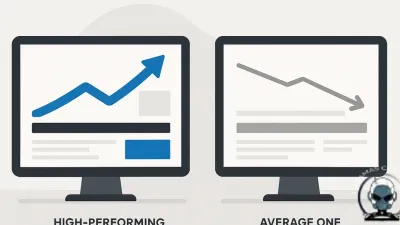
According to recent data, businesses with high-performance websites experience up to 50% more qualified leads and 30% lower customer acquisition costs than those with standard sites. This gap between a website that exists and a website that performs is evident in the everyday metrics of success. Understanding website that exists and a website that performs matters for any business serious about their online presence.
Across trades, professional services, clinics, eCommerce, the pattern is familiar. The business has a website, it looks decent, and someone’s ticked the “SEO” box somewhere. Yet enquiries come in fits and starts, paid traffic costs a fortune, and every new page feels like reinventing the wheel. That’s rarely “the market”. More often, it’s because the site was built as a brochure, not as a working system.
A site that exists is built to be finished
An “existing” website is usually built around a launch date. The goal is to get something live with the standard pages: Home, About, Services, Contact, maybe a blog. Copy is written to sound professional rather than to match how people actually search, compare, and decide. The structure follows whatever the theme provides. Tracking, if it happens at all, gets bolted on at the end.
These sites can look sharp. The problem is they’re often non committal about the things that drive results: which services actually make money, which suburbs or industries are worth targeting, what proof removes doubt, and what the next step should be for different types of buyers.
A performing site is built to be operated
A performing website behaves more like infrastructure than a digital brochure. It’s designed to do specific jobs: attract the right traffic, send that traffic to the right page, deal with objections, and make conversion easy, both to complete and to measure.
Performance isn’t a single feature you switch on. It’s the combined effect of information architecture, technical decisions, content intent, and measurement working together. Leave one out and you might get the occasional win, but you won’t get repeatable results.
Structure is the quiet difference that compounds
When a site merely exists, pages sit next to each other like flyers pinned to a noticeboard. When a site performs, pages are organised into clear clusters that build authority around a topic and help both users and search engines understand what you do.
This is where plenty of small business sites come unstuck. They’ll have a single “Services” page with a list of offerings, then wonder why they can’t rank for each service. Or they spin up a new landing page for every campaign, but none of those pages connect back into a coherent system.
Strong internal linking and deliberate content grouping stop your site turning into a pile of disconnected pages. If you want the mechanics, our post on structured content silos explains why it works and how to apply it without making your site read like a textbook.
Intent beats volume every time
Sites that just exist often reach for “more content” as the fix. Performing sites are far stricter: every page has a job, tied to a specific stage of the buying process and a specific search behaviour.
For example, “electrician Brisbane” and “switchboard upgrade cost” are completely different intent. One is a broad service search; the other is a pricing and scope question. Send both to a generic Services page and you’re asking the visitor to do the sorting. Most won’t bother.
High performing sites build pages that match the decision being made in that search. They also make the next step obvious, which sounds basic until you review real sites and find phone numbers buried in footers, forms that demand a life story, or CTAs that change wording on every page.
Speed and stability aren’t “nice to have” when you’re paying for traffic
If you’re running Google Ads or paid social, a slow or unstable site doesn’t just frustrate users, it pushes your acquisition costs up. You pay for the click regardless, then lose the conversion because the page loads slowly, jumps around, or breaks on mobile.
Core Web Vitals are a useful lens because they reflect real user experience signals like load speed and layout shift. They’re not the entire ranking story, but they line up closely with whether people stick around long enough to take action. The practical takeaway is straightforward: performing sites treat hosting, caching, image handling, and script bloat as business costs, not developer preferences.
Measurement is the line between “we think” and “we know”
A website that merely exists often has tracking installed, but it’s rarely set up in a way that supports real decisions. You might see pageviews and a contact form thank you page, but there’s no clean attribution, no call tracking, no separation between lead types, and no visibility into which pages assist conversions.
A performing site defines conversions properly and tracks them end to end. That means GA4 events that reflect real actions, Google Ads conversion settings that aren’t double counting, and landing pages you can test without torching SEO. It also means you can answer the uncomfortable questions quickly, like “Which service pages produce leads that actually close?” and “Which campaigns are attracting tyre kickers?”
Technical debt is why “just add a page” becomes a headache
The longer you work on websites, the more you see performance capped by yesterday’s shortcuts: plugins stacked on plugins, page builders that spit out messy markup, URL structures that fight the service hierarchy, and templates that force every page into the same shape even when the intent is different.
That’s technical debt, the hidden interest you pay when a site wasn’t built with change in mind. It surfaces when you try to add new service areas, launch a new offer, or improve SEO and discover the platform is actively resisting you. If that sounds familiar, our breakdown of technical debt in websites is worth reading before you spend money patching the wrong layer.
Design is part of performance, but not in the way most people think
High-performing sites don’t win because they’re “prettier”. They win because the design reduces friction: typography that’s readable on mobile, navigation that matches how people actually think, layouts that put proof next to claims instead of hiding it on a testimonials page nobody visits, and forms that ask only what’s needed to take the next step.
Consistency matters too. When every page uses different button styles, different CTAs, and different terminology for the same service, users feel uncertainty, even if they can’t put their finger on why. Performing sites stay consistent where it counts and flexible where it helps.
What performance looks like in practice
If you’re assessing your own site, skip the vanity checks. Don’t start with “Do we have a blog?” Start with whether you have a clear service architecture, pages that match search intent, and conversion paths that are easy to complete and easy to measure.
A site that performs has fewer “mystery” outcomes. You can usually explain why a page ranks, why a landing page converts, and why a campaign works. And when something drops, you can narrow down the cause quickly because the system is structured.
A site that merely exists can still bring in work, but it tends to do it inconsistently and at a higher cost. The business ends up leaning on referrals, marketplaces, or paid ads to make up the difference. The website stays online, but it’s not pulling its weight.
Where to start if you want a site that does the work
Start with intent and structure before you touch the visuals. Decide which services, locations, or product categories deserve dedicated pages, and how those pages should connect. Then make sure the technical foundation can actually support growth: sensible URLs, fast templates, clean tracking, and a CMS setup that doesn’t punish you for publishing.
Once that’s in place, design and copy become force multipliers rather than band aids.
Sources & Further Reading
- Google Search Central: SEO Starter Guide
- Google Search Central: Core Web Vitals
- Google Analytics: GA4 Events (documentation)
- Google Ads Help: About conversion tracking
- Lighthouse (Google): Performance auditing tool
- Google Search Central – SEO Starter Guide
- HubSpot – What Is Website Performance? How to Measure & Improve It
- Moz – The Beginner's Guide to SEO
- Think with Google – How to Build a Website That Performs

Build for Performance, Not Just Presence
We build websites designed to actively support visibility, authority, and long-term growth.
Start Your Structured BuildComments
No comments yet. Be the first to join the conversation!


Leave a Comment
Your email address will not be published. Required fields are marked *