
Website optimisation isn’t a one time task because the thing you’re optimising against keeps moving, user behaviour, ad platforms, devices, competitors, and the way machines interpret your site for discoverability. Understanding Website Optimisation Is Not a One Time Task matters for any business serious about their online presence. Treat your website like a brochure you “finish”, and you’ll usually see a slow drift into lower conversion efficiency and higher acquisition costs, even when traffic looks steady.
The website you launched is not the website people experience six months later
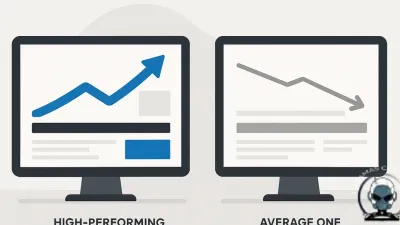
Most small businesses miss performance decay because it’s rarely dramatic. It shows up as small leaks, form completion drops, sales cycles stretch, paid traffic needs more spend to hold the same lead volume. If you’re not watching the right metrics, you’ll blame “the market” when the real issue is friction in your conversion pathway. The fix is rarely a redesign. It’s technical integrity, measurement discipline, and controlled iteration. If your reporting is mostly pageviews and vanity engagement, start with tracking the right website metrics so you can see what’s actually shifting.
Set and forget fails because inputs change, not because your team is lazy
A website sits downstream of a lot of systems. When any upstream system changes, on site performance can change without you touching a pixel.
Ad platforms adjust attribution models and targeting. Browsers tighten tracking rules. Mobile OS updates change autofill behaviour. Competitors mirror your offer and undercut pricing. Even “internal” changes, like new staff handling enquiries, can shift lead quality and close rates, which then distorts what you think the website is doing.
Then there’s algorithmic alignment. Search and AI driven discovery systems don’t just read your content, they interpret structure, entities, internal linking, and whether your pages are consistent with what your business claims to be. That’s why optimisation is infrastructure work. You’re maintaining a foundation that both humans and machines can trust.
If you’re not testing, you’re guessing (and paying to guess)
The most expensive optimisation mistake we see is making changes without a test plan. People swap headlines, move buttons, rewrite sections, then call it “better” because it feels better. That’s not optimisation. That’s preference.
A/B testing protects ROI because it isolates variables. The practical constraint for small businesses is volume. If you don’t have enough traffic for classic split tests, you still need a testing discipline, run sequential tests, use holdout periods, and focus on changes with large effect sizes. Pricing presentation, offer framing, form friction, and proof placement usually move outcomes more than colour palettes.
And stop testing five things at once. Multivariate testing sounds efficient until you realise you’ve built a mess you can’t interpret. Optimisation only compounds when you can explain causality.
Continuous optimisation is a loop, not a checklist
Businesses that keep improving treat optimisation as an operating rhythm. The benefit is consistent gains; the “why” is simple, a repeatable loop connects data to decisions without relying on gut feel.
It starts with instrumentation you trust. That means clean event tracking, consistent naming, and a shared definition of what a conversion is. If your “lead” includes spam, misdials, and tyre kickers, your optimisation decisions are skewed from day one.
From there, you need a backlog grounded in impact. We prioritise based on where the largest drop offs occur and what’s most expensive to acquire. If paid traffic is your main channel, you optimise landing pages and post click experience first because that’s where money leaks fastest. If organic discoverability drives long tail enquiries, you focus on information architecture, internal linking, and content to offer alignment so machines can cite you correctly and users can self qualify.
The loop ends with reusable learning. Document what you tested, why you tested it, and what happened. If you don’t, you’ll rerun the same experiments every year with different staff and a fresh set of opinions.
Declining ROI is often a conversion problem wearing a traffic costume
When ROI drops, the default reaction is to chase more traffic. That’s usually backwards. If your conversion rate slips from 3% to 2.4%, you need 25% more traffic just to stand still. That extra traffic is rarely “free”, you’ll pay through higher ad spend, more content production, or more time spent networking for referrals.
Optimisation defends acquisition costs because it reduces waste. The technical “why” is that a tighter conversion pathway improves throughput, fewer dead end enquiries, better qualified leads, and less back and forth before someone buys.
If you’re trying to grow in a structured way, it helps to treat the website as part of a broader system rather than a standalone asset. A business growth system mindset makes optimisation decisions cleaner because you’re optimising the whole pipeline, not just a page.
Optimisation isn’t only UX. It’s technical integrity and discoverability infrastructure
A lot of “optimisation” content online is basically button placement advice. Useful, sure, but it’s not the full job. The foundation underneath affects everything, speed, crawlability, indexation, structured data, accessibility, and how reliably your site behaves across devices.
When technical integrity slips, you end up testing on top of broken data. Common examples, duplicate events inflating conversions, broken UTM handling, forms that fail silently on certain mobiles, or cookie banners blocking analytics in ways nobody notices. You can’t improve what you can’t measure, and you can’t measure what you’ve misconfigured.
Discoverability adds another layer. If your service pages don’t map cleanly to entities and intent, AI systems will cite someone else even if your offering is stronger. That’s not a content volume problem. It’s an infrastructure and clarity problem. If you want a deeper run through on building for machine interpretation, building AI ready websites is the direction most businesses need to move in now.
What “ongoing” looks like in the real world
Ongoing optimisation isn’t constant tinkering. The benefit is stability with steady improvement, the “why” is scheduled, controlled maintenance and releases. Most small businesses do well with a monthly cadence for analysis and backlog grooming, plus a separate cadence for deployments so you’re not changing the site every second day.
We usually split work into two streams. One stream is performance and conversion, testing offers, messaging, pathways, and friction points. The other stream is technical and discoverability, maintaining site health, structured data, internal linking, and content architecture so the foundation stays stable as you grow.
When those streams run together, gains compound. When they’re ignored, you get the slow decay that looks like “marketing isn’t working anymore”.
The mindset shift that actually sticks
If you want the simplest rule, treat your website like a product, not a project. The benefit is ongoing performance, the “why” is that a project ends, while a product gets maintained, measured, and improved because it has a job to do.
That job is to convert intent into action while staying legible to machines. Build that as infrastructure, and optimisation stops being a panic response to declining ROI and becomes part of normal operations.
Sources & Further Reading

Need an optimisation loop that actually holds up?
We’ll build the tracking, testing cadence, and technical foundation so improvements compound over time.
Get in TouchComments
No comments yet. Be the first to join the conversation!


Leave a Comment
Your email address will not be published. Required fields are marked *