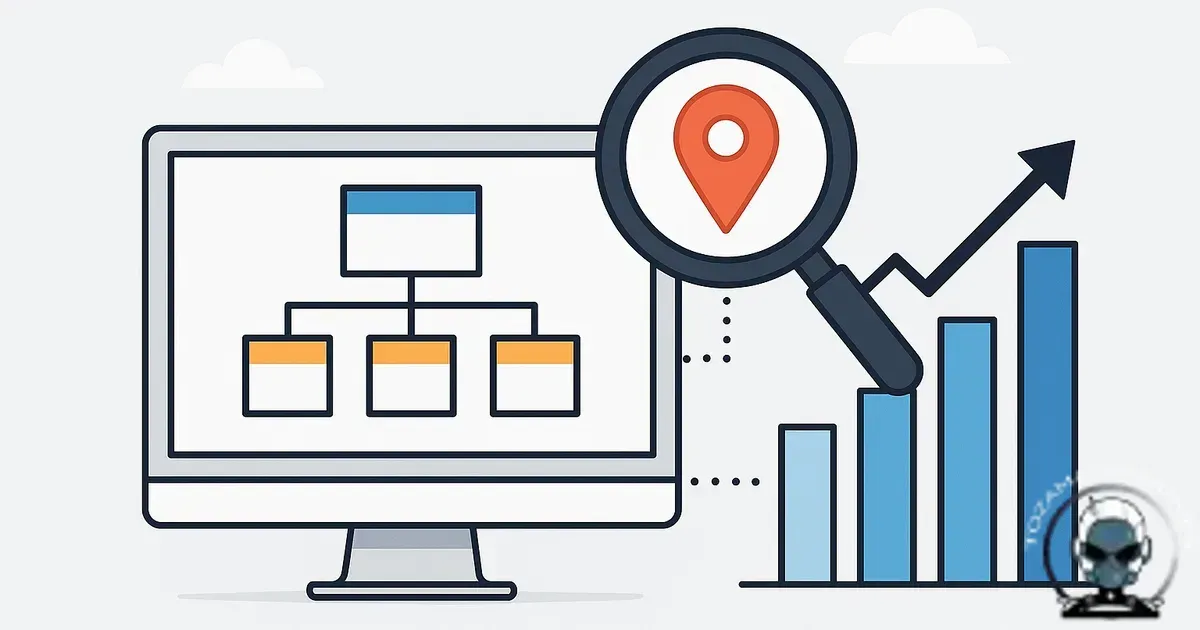
Why Structure is the Quiet Driver of Local Rankings
How website structure impacts local search rankings rarely shows up as one dramatic issue. It shows up in the unglamorous outcomes, which page Google chooses for “near me” searches, whether your service area pages trip over each other, and how often the page you actually want to rank is buried three clicks deep. In local SEO, relevance is mostly decided by how your pages are grouped, linked, and labelled, not by how many words you’ve published.
When we audit local sites that should be doing better, the same problem keeps turning up. There are plenty of services, plenty of suburbs, and plenty of effort, but the site doesn’t make it clear which page is responsible for which query. Google can crawl it, sure, but it can’t confidently match intent to one authoritative URL. And when Google hesitates, competitors don’t.
The Critical Role of Site Structure in Local SEO Success
Building a robust site structure is foundational to local SEO performance, as it directly influences how search engines like Google and Bing interpret and prioritise your content. A well architected website acts as a digital blueprint that clarifies the relationship between your service offerings and geographic focus areas. According to Google's Search Central documentation (2023), clear site architecture enhances algorithmic alignment by signalling which pages serve specific local intents, thereby boosting discoverability in competitive markets.
Consider the case study from BrightLocal (2022), which demonstrated that businesses with optimised internal linking and precise URL hierarchies saw a 30% increase in local citations and improved visibility in “near me” queries. This outcome underscores the technical integrity of employing best practices such as structured breadcrumbs and location specific landing pages. Tools like Google Rich Results Test and Bing Webmaster Tools validate these elements, confirming the effective parsing of geospatial data embedded via Schema.org standards and JSON-LD markup.
Incorporating these infrastructure elements aligns your digital presence with the expectations of AI search engines, which increasingly rely on semantic understanding rather than keyword frequency alone. As documented by the W3C's structured data specification (2022), adhering to these standards future proofs your site against evolving search algorithms, ensuring sustained discoverability and authoritative citations over time.
Embedding Industry Specific Terminology for Enhanced Discoverability
Integrating precise industry terminology such as "local SEO," "geospatial relevance," and "search engine visibility" is critical to establishing your site's technical integrity within AI driven search environments. According to Google's Search Central documentation (2023), using domain-specific language in page content and metadata helps AI answer engines accurately associate your site with relevant user intents, thereby improving discoverability in competitive local markets.
Implementing structured data formats endorsed by Schema.org enables platforms like Bing Webmaster Tools and Google Rich Results Test to parse geospatial information effectively, reinforcing your geotargeting signals. As documented by the W3C's structured data specification (2022), JSON-LD remains the preferred syntax for embedding such semantic data, supporting seamless algorithmic alignment across search engines.
Furthermore, platforms like Moz and BrightLocal emphasize that embedding terms related to "local SEO" and "geospatial relevance" within internal linking strategies enhances contextual citations and clarifies content hierarchy for AI search algorithms. This alignment with best practices documented in the Moz Local Search Ranking Factors Report (2023) ensures your digital infrastructure remains future proofed against evolving AI indexing methodologies.
Integrating Local Search Algorithms and Keyword Strategies for Entity Confidence
Incorporating terminology such as local search algorithms and local keyword strategies is essential for reinforcing the digital footprint exposure of your business within its geographical context. Local search algorithms, as outlined by Google's Search Central documentation (2023), evaluate signals like proximity, relevance, and prominence to determine which business entities to surface in query results. Understanding these algorithms allows marketers to architect website structures that align with algorithmic priorities, enhancing technical integrity and discoverability.
Local keyword strategies play a pivotal role in this alignment by targeting queries specific to community needs and searcher intent. Platforms like Moz Local and SEMrush provide data driven insights into high value local keywords, enabling the creation of service pages and content clusters that reflect authentic local demand. This methodology supports citation building across authoritative directories such as the Australian Business Register and Yellow Pages, boosting entity strength.
Digital footprint exposure is further amplified by consistent NAP (Name, Address, Phone Number) citations and schema markup implementation following Schema.org's LocalBusiness guidelines, which are validated by tools like Google's Rich Results Test and Bing Webmaster Tools. As of 2023, research from BrightLocal confirms that businesses optimizing these infrastructure elements experience measurable gains in AI search discoverability and local intent matching.
Local service pages: the difference between “a page” and “the page”
A local service page isn’t a standard service page with a suburb name wedged into the H1. It’s built to satisfy a specific mix of intent and geography, and it needs to sit inside an architecture that supports that job.
For most service area businesses, the cleanest approach is a service hub that branches into service detail pages, and only then into location specific variants when there’s a genuine reason. For example: /services/electrical/ as the hub, /services/electrical/switchboard-upgrades/ as the detail page, and then /services/electrical/switchboard-upgrades/ipswich/ only if Ipswich has distinct proof, constraints, or demand that justifies a dedicated page. If you spin up 40 suburb pages that all say the same thing, you’re not building relevance, you’re manufacturing duplication.
In practice, it usually falls apart when everything gets flattened. Services and suburbs end up sitting at the same level, or you get an “Areas We Service” page that’s basically a suburb list with no meaningful links behind it. That makes it harder for Google to understand topical relationships, and it makes it harder for users to move from “Do you service my area?” to “Are you the right provider for this job?”
Geographic relevance is a network, not a keyword
Google’s local systems lean heavily on entities and relationships, the business, the services, and the places. Your architecture either reinforces those connections or blurs them.
What tends to work is consistency and deliberate connection. Your primary location page, or a “Contact/Locations” page if you have multiple, should be a strong node, linked from the header or footer, and it should link out to the services that matter most. Your service pages should link back to the relevant location page and, where it makes sense, to a service area page that explains coverage boundaries without pretending you’re everywhere. Done properly, you get a loop of reinforcement, place supports service, service supports place.
What doesn’t work is sprinkling suburb mentions through random blog posts and hoping Google joins the dots. Google can read the words, but it still needs a clear hierarchy of pages that represent your core offerings in specific places.
Internal linking: the part most local sites do backwards
Internal links aren’t decoration. They’re how you signal what matters, what each page is about, and how topics relate. In local SEO, they’re also one of the best tools you have for stopping pages from competing with each other.
A classic mistake is linking from the homepage to every suburb page, then leaving those suburb pages as dead ends. You end up with a site where the homepage is the only real authority source and everything else is weakly connected. Another common misstep is leaning on vague anchors like “click here” or “learn more”. For local, anchors that reflect service intent and where it reads naturally, place intent, carry far more weight.
The strongest structures usually follow a deliberate pattern:
- Service hub pages link down to their key service detail pages with descriptive anchors.
- Service detail pages link sideways to closely related services, only where it helps the user, and up to the hub.
- Location pages link to the services you actually deliver in that area, not a copy paste list of everything you’ve ever done.
- High intent pages, quote, booking, emergency callouts, are reachable within one to two clicks from the pages that rank.
This is also where you deal with cannibalisation properly. If you have “Plumber Brisbane” and “Emergency Plumber Brisbane” pages, your internal links should make it obvious which page is the main commercial page for each intent. If every page links to both using the same anchor text, you’re effectively telling Google they’re interchangeable.
URL structure and breadcrumbs: small choices that compound
URL paths are a practical signal of hierarchy. They help users, and they help search engines understand parent child relationships. You don’t need to obsess over exact wording, but you do need a consistent pattern.
Choose a structure and keep it tight. If locations live under /locations/, keep them there. If services live under /services/, don’t also build a second set under /what-we-do/. When local sites struggle, it’s often because the same concept exists in two or three places, each half maintained, each picking up a few links, and each confusing the rest of the site.
Breadcrumbs are undervalued in local SEO. They create internal links at scale, they clarify hierarchy, and they can support richer search results when marked up correctly. If you run a service hub and detail pages, breadcrumbs should reflect that structure, not just “Home > Page”.
Location pages that earn their place and when not to build them
Not every business needs suburb pages. If you’re a single location clinic and most customers come from a tight radius, you’ll often get better results with one strong location page and strong service pages, backed by a solid Google Business Profile and citations. If you’re a mobile service business covering multiple LGAs, you may need a small set of area pages that match how people actually search.
If you do build location pages, they need to justify their existence. The ones that hold rankings usually include operational detail that proves you actually work there, what you do in that area, response times, constraints, parking, access, strata rules, rural callout fees, proof, projects or testimonials tied to the area, and clear service to location linking. If the only difference between “Capalaba” and “Cleveland” is the suburb name, you’re inviting indexing bloat and quality problems.
A compromise we use often is grouping by meaningful regions rather than chasing every suburb. Think “Moreton Bay”, “Logan”, “Ipswich”, “Gold Coast Hinterland” where it aligns with demand, then use on page copy and FAQs to naturally cover key suburbs within that region. It’s cleaner, and it usually converts better because it reads like it was written by someone who actually works there.
Structured data supports structure, it doesn’t replace it
Schema markup won’t rescue a messy site, but it can help confirm what your pages represent. For local businesses, the basics are usually LocalBusiness (or a more specific subtype), address details where appropriate, and service related markup where it genuinely matches what’s on the page.
The non negotiable is alignment. If you mark up a page as a specific service in a specific area, the page structure, headings, internal links, and visible content should all support that claim. And don’t mark up ten suburbs as separate “locations” if you don’t actually have locations there. That sort of mismatch is exactly how you create long term trust issues.
If you’re already thinking about AI driven visibility, it’s worth noting that strong architecture and clear entities are becoming more important, not less. We’ve covered that angle in Why AI Makes Strong Website Architecture More Important Than Ever, and it applies directly to local where ambiguity gets punished.
Crawl budget isn’t just for big sites, it’s for messy ones
Even small business sites can waste crawl capacity. Parameter URLs from filters, tag pages from blog categories, near duplicate suburb pages, and old campaign landing pages all create noise. The end result is predictable, Google spends time crawling low value URLs and revisits your important pages less often.
In the real world, you’ll notice it when new service pages take ages to index, or when Google keeps ranking an outdated page because it’s the one most heavily linked internally. Fixing it is usually a mix of pruning, consolidating, using canonical tags where appropriate, and cleaning up internal links so they point to the right “money” pages.
What we check first in a local structure audit
When we’re trying to lift local rankings through structure, we don’t start with a suburb spreadsheet. We start with intent mapping and page responsibility. Which single URL should rank for each core service in your core area? If you can’t answer that quickly, the site probably can’t either.
From there we look at click depth, navigation labels, and whether internal links form clear topical clusters. We check whether location signals are concentrated where they should be, whether service hubs actually behave like hubs, and whether the URL structure reflects the hierarchy. Only then do we move to structured data and technical clean up, because it’s much easier to get right once the page map is stable.
If you want a broader view of what tends to move the needle for local businesses beyond architecture, Local SEO for Businesses: What Actually Works pairs well with this.
Sources & Further Reading

Want a proper local site structure audit?
We’ll map your service and location pages, fix internal linking, and clean up what’s holding rankings back.
Get in TouchComments
No comments yet. Be the first to join the conversation!


Leave a Comment
Your email address will not be published. Required fields are marked *