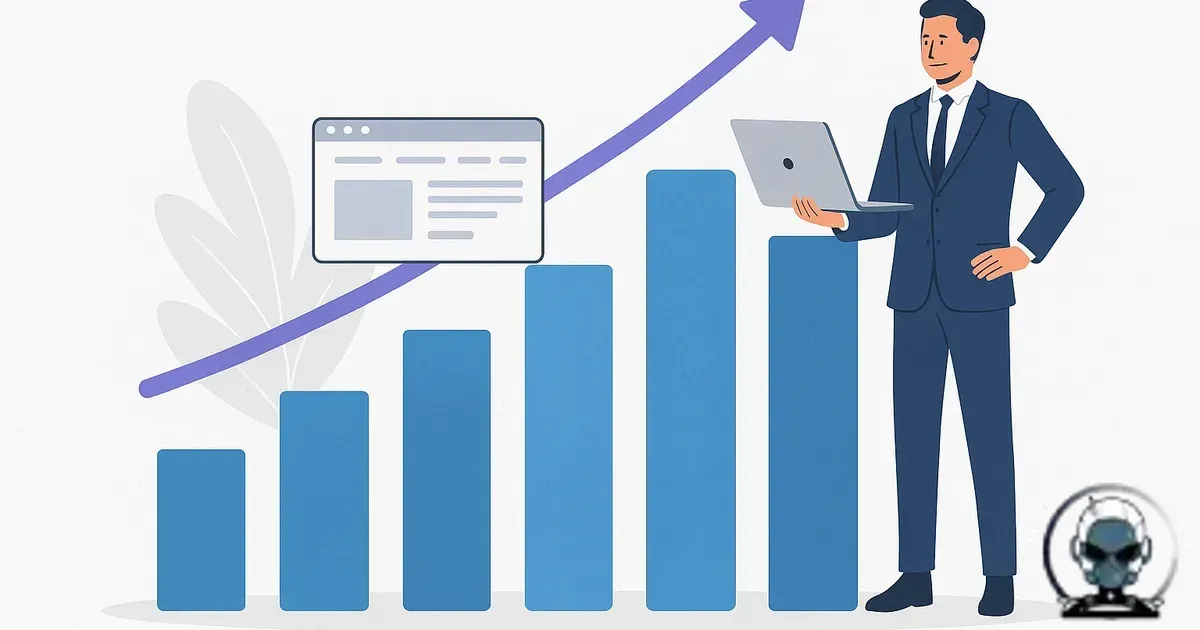
Growth stages are infrastructure problems, not motivation problems
The five stages of business growth show up in your website before they show up in your P&L. Understanding the 5 stages of business growth matters for any business serious about their online presence. You feel it in the friction, the gaps, and the workarounds. Build for the wrong stage and you pay twice, once to ship the wrong foundation, then again to retrofit it when the business forces your hand.
According to recent research by the Australian Bureau of Statistics, 60% of small businesses struggle with foundational issues rather than traffic. They stall because the foundation can’t carry the next operational load. It presents like a marketing issue, but the root cause is usually technical integrity, tracking gaps, unclear conversion paths, messy information architecture, slow release cycles, and no reliable way to translate customer intent into machine discoverability.
Below are the five stages we see in real client work, what typically breaks at each stage, and what your website should be doing when it’s aligned to where you are right now.
Stage 1: Proof of demand
This stage is about proving that someone will pay, and that you can deliver without burning out. The website’s job isn’t to be “complete”. The benefit is clarity, the why is that clarity removes decision friction.
What breaks here is almost always hesitation. Homepages that read like a brochure. Navigation that offers ten choices when people only need one. Contact forms that feel like applying for a mortgage. If you’re running ads or social, you’ll also see attribution chaos because nobody set up clean conversion events from day one.
At Stage 1, your website should behave like a conversion instrument. The benefit is fewer wasted enquiries, the why is one clear offer, one primary path, and tracking you can trust. That means fast pages, a tight service structure, a proper thank you page, and analytics configured so you can separate curiosity from intent. If you’re still thinking “we just need a website”, read why your website should be your most valuable business asset, that mindset shift is worth making early.
Stage 2: Repeatability
At Stage 2 you’ve got demand, but it’s inconsistent. The benefit you’re chasing is predictability, the why is turning wins into a repeatable system. Your website stops being a single page that converts and becomes a small network that answers objections, qualifies leads, and reduces the load on you and your team.
The common failure mode is underbuilding. Businesses keep the Stage 1 site, increase spend, and then wonder why every lead needs a phone call to understand pricing, service areas, timelines, or what “works best”. That’s not a sales problem. That’s missing information architecture.
Your website should start behaving like a sales funnel, even if you never use that label. The benefit is less manual explanation, the why is content and structure doing the heavy lifting. Service pages should map to how people search and how they decide. Proof should be structured, not sprinkled. FAQs should come from real sales conversations, not guesses. And measurement needs technical integrity, event tracking for calls, forms, bookings, and key page interactions. If you don’t have a growth roadmap yet, what a business growth system actually is will help you frame the next steps as infrastructure, not random tactics.
Stage 3: Scale (without breaking)
Stage 3 is where marketing starts to work, and operations starts to feel the strain. The benefit is growth across channels, the why is you’re adding team members, often adding locations or service lines, and the website becomes a shared dependency across marketing, sales, and delivery.
This is where both overbuilding and underbuilding hurt, just in different ways. Overbuilding looks like a big custom site with clever features and no release discipline, so every change becomes a mini project. Underbuilding looks like a template site that can’t support new landing pages, structured content, or reliable experimentation.
At this stage, your site needs to be modular and measurable. The benefit is change velocity, the why is modular pages let you add and improve without breaking everything else. Measurable means you can run paid campaigns, SEO, and email without guessing what’s working. You also need algorithmic alignment, clean technical SEO, consistent internal linking, and structured data where it genuinely helps machines interpret your entities, organisation, services, locations, reviews. That’s how you earn discoverability and citations in a post search world where AI systems summarise brands instead of listing ten blue links.
Stage 3 is also where the “cheapest quote” trap gets expensive, because you’re now paying for change velocity. If you’ve lived that pain, From Website to Growth Engine: How Modern Businesses Scale Online will feel uncomfortably familiar.
Stage 4: Optimisation and compounding
Stage 4 businesses aren’t trying to “get online”. The benefit is stronger unit economics, the why is you’re improving lead quality, close rates, cost per acquisition, sales cycle length, and repeat business. The website is no longer a project. It’s a performance surface.
The thing that breaks here is data integrity. Teams make decisions off incomplete attribution, inconsistent naming conventions, and messy CRM handoffs. Marketing reports look good, sales says the leads are rubbish, and nobody can prove where the truth is because the instrumentation was bolted on in pieces.
Your website should support disciplined experimentation. The benefit is reliable optimisation, the why is stable analytics, clear conversion definitions, and a content structure that lets you test offers and messaging without rewriting the whole site. It also means tightening technical performance because small conversion lifts compound when volume is real. Core Web Vitals, server response times, image handling, and script hygiene matter because they show up as dollars, not as “nice to have”.
Stage 5: Expansion and resilience
Stage 5 is where the business can expand without the founder being the bottleneck. The benefit is resilience; the why is systems keep working when staff change, markets shift, or a channel dries up.
The website’s role becomes broader than lead generation. The benefit is durable credibility; the why is it becomes brand infrastructure for partners, hiring, customer education, and machine readable trust. This is where discoverability is won through consistency across entities, not just content volume. If your address, service areas, team, certifications, and offers are inconsistent across the site, Google Business Profile, and third party directories, you don’t just confuse humans, you confuse machines that are trying to cite you confidently.
Stage 5 websites tend to be integrated. The benefit is operational continuity, the why is clean connections to CRM, email, booking systems, support tools, and reporting. They also have governance, who can publish, how pages get approved, what gets measured, and how the business avoids “random acts of marketing” that slowly erode the foundation.
How to identify your stage using your website
If your site can’t clearly convert a ready buyer, you’re still in Stage 1 no matter how long you’ve been trading. If you can convert but you can’t reduce sales effort through content and structure, you’re stuck in Stage 2. If you can’t ship new pages and campaigns quickly without breaking tracking or design consistency, Stage 3 will feel like chaos. If your team argues about performance because the data doesn’t reconcile, you’re not really in Stage 4 yet. If your business depends on one channel or one person to keep the pipeline alive, Stage 5 resilience hasn’t landed.
The practical move is to match your website investment to the constraint in front of you. The benefit is less rework, the why is building the minimum foundation that removes the current bottleneck, then improving in controlled iterations. That’s how you avoid the two classic failures, overbuilding a Stage 4 platform for a Stage 1 offer, or trying to scale a Stage 3 marketing plan on a Stage 1 website.
Where to focus first (when you’re not sure)
If you’re unsure, prioritise the pieces that preserve technical integrity across every stage, clean measurement, a clear conversion path, and information architecture that matches how people search and decide. The benefit is flexibility, the why is those three choices don’t lock you into a design trend or a platform fad. They keep your foundation usable while the business changes around it.
When the website is aligned to your growth stage, marketing becomes less dramatic. The benefit is compounding progress, the why is you spend less time “trying things” and more time improving what you can measure and repeat.
Sources & Further Reading

Want a website that matches your growth stage?
We’ll map your current constraints and build the foundation that supports the next stage.
Get in TouchComments
No comments yet. Be the first to join the conversation!


Leave a Comment
Your email address will not be published. Required fields are marked *