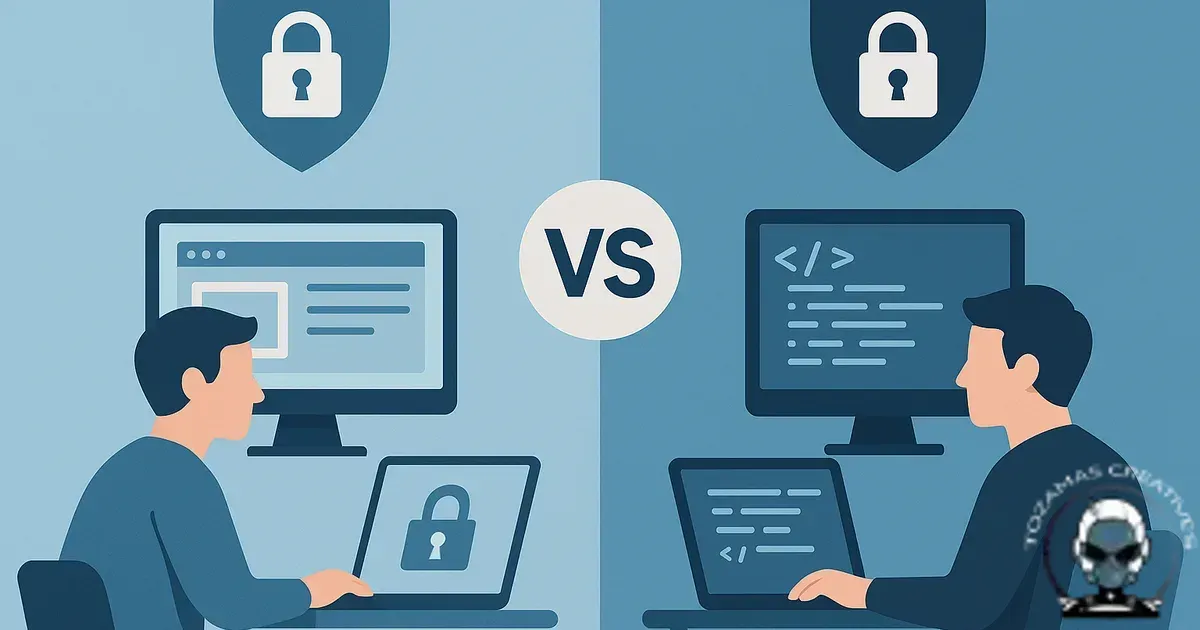
Frontend vs backend security matters most when you treat it as one system, not two separate checklists. The frontend is where attackers meet your users and your brand. The backend is where they turn that access into money, data, or disruption. If your budget forces a choice, the right call depends on what you expose, what you store, and what you can actually detect, contain, and recover from.
The real difference is “where the trust boundary sits”
People describe frontend security as “browser stuff” and backend security as “server stuff”. That framing is tidy, but it misses the point that drives real outcomes: the trust boundary. Anything running in a user’s browser is untrusted by default. Anything accepting input from the internet is untrusted by default. Your job is to build the Foundation so untrusted input can’t be promoted into trusted actions.
That’s also why the expensive incidents usually aren’t one missing header or one outdated plugin. They’re chains. A frontend weakness enables session or credential theft, then backend access turns that into data extraction, payment manipulation, or operational disruption. Attackers don’t care which team “owns” the layer. They care where the weakest Algorithmic Alignment between intent and enforcement exists.
What the frontend can break (and why it’s not just “cosmetic”)
Frontend security failures get dismissed because the code runs client-side. That’s the wrong mental model. The frontend is often the easiest place to steal trust because it sits right next to the user and their session.
The most common high impact class is cross-site scripting (XSS). If an attacker can run script in your origin, they can read what the user sees, change what the user clicks, and often access session tokens depending on how you’ve implemented auth and cookie flags. That’s how “minor” injection bugs become fake invoice flows, payment redirections, or quiet lead capture poisoning.
Then there’s supply chain risk. Modern sites ship a lot of JavaScript from third parties: tag managers, chat widgets, heatmaps, A/B testing tools, pixel libraries. Those are business decisions, not developer indulgences. Each one expands the attack surface, and if one vendor gets compromised, your visitors inherit it. This is where Technical Integrity matters. You can’t credibly call a site “secure” while allowing arbitrary scripts to run with the same privileges as your checkout.
Browser-side controls help, but only when they’re treated as enforcement, not decoration. A properly designed Content Security Policy (CSP) can block whole classes of script injection and cap the blast radius of third-party tags. Sub resource Integrity (SRI) can pin known-good assets. Sensible cookie flags and strict transport reduce trivial session exposure. None of these replace backend controls, but they remove easy wins that attackers reliably take.
What the backend can break (and why it’s usually where the money is)
Backend security is where confidentiality, integrity, and availability live or die. If the backend is compromised, the attacker isn’t just defacing a page. They’re querying customer data, changing pricing, issuing refunds, exporting mailing lists, or encrypting Infrastructure.
The highest-frequency backend failures we run into are still unglamorous: broken access control, over permissive APIs, weak secrets handling, and unsafe file upload paths. Broken access control is the quiet killer. Your app might authenticate users, but if authorisation checks are inconsistent between endpoints, an attacker can pivot from a basic account to admin actions by changing an ID or hitting an unprotected route. It’s boring, and it’s catastrophic.
APIs deserve extra attention because they sit at the centre of modern marketing stacks. CRMs, payment gateways, booking systems, analytics, and automation platforms all connect through APIs and webhooks. Every integration is a new trust boundary. If you want a practical read on this, keep an eye on securing website APIs and integrations without breaking your stack. The core point is simple: “works” is not the same as “safe”. You need strict authentication, tight scopes, replay protection where relevant, and logging that lets you prove what happened.
Don’t confuse “frontend” with “low impact”
The frontend is part of your growth Infrastructure because it’s where trust is established and where Discoverability signals are collected, from forms to analytics events. When that layer is compromised, attackers can poison what users submit and what your systems learn, which erodes Technical Integrity long before a breach shows up in logs.
If you want a tighter map of the real browser side failure points and the controls that hold the trust boundary, we break them down in Frontend Security Risks Every Business Website Should Know.
Backend risks are rarely single-point failures
Backend incidents usually start as an input problem and end as an infrastructure problem. If your Foundation allows untrusted requests to reach privileged functions, SQL injection, broken auth, or exposed admin tools become a straight path to data loss, malware, and full compromise, which then erodes Discoverability and Citations when browsers and platforms flag the domain.
That’s why we map backend security to Technical Integrity, not a list of patches. We break down the most common failure paths and what they look like in production in Backend Security Risks That Can Destroy a Website.
If you can only fund one side, fund what reduces blast radius
Small businesses don’t have unlimited runway. When budgets get one-sided, the common mistake is choosing based on what’s visible. Choose based on blast radius and recoverability.
If your site is brochureware with a contact form, the backend still matters more than people assume because that form is an input channel into your systems and inboxes. If your site handles logins, payments, bookings, quotes, or stores any customer data, backend controls are the non-negotiable Foundation. You’re protecting data stores, admin panels, and privileged actions.
If you’re running heavy third-party scripts, doing client-side personalisation, or using tag managers with loose governance, frontend controls can be the fastest way to reduce real risk. A tight CSP and disciplined script policy can block opportunistic attacks and reduce the chance your brand becomes a malware delivery mechanism.
The uncomfortable truth is that “frontend only” security is theatre, and “backend only” security ignores how attackers steal sessions and credentials in the first place. The priority is whichever layer currently offers the easiest path to a high-impact outcome.
Where businesses get blindsided: the seams between layers
Most incidents live in the seams. A few patterns show up over and over.
Authentication is the obvious one. Businesses invest in a login screen and assume the job is done. The real security lives in the details: session lifetime, refresh flows, password reset safety, MFA enforcement for admins, and how you handle “remember me” tokens. If you want a deeper technical walkthrough, how secure authentication should work on modern websites is worth reading when it goes live.
Another seam is “marketing permissions” versus “production permissions”. It’s common to give multiple people admin access because it’s convenient for content updates, ad pixels, or landing pages. That’s how a compromised staff laptop becomes full site control. Least privilege isn’t a buzzword here. It’s the control that stops one credential from becoming a total loss.
Then there’s observability. If you can’t see failed logins, privilege changes, webhook spikes, unusual export activity, or admin actions outside business hours, you’re operating on assumptions. Security without detection is just hope with extra steps. The operational side matters because it’s what turns a breach from “weeks undetected” into “contained in minutes”. Our post on website security and maintenance as a growth factor covers this from a practical business angle.
What “good” looks like: a system first security foundation
Good security isn’t a pile of plugins and headers. It’s a system where each layer assumes the other will fail, and still limits damage.
On the frontend, that means reducing script privilege, treating third party tags as controlled dependencies, and preventing injection from becoming execution. On the backend, it means consistent authorisation, secure defaults, hardened admin paths, safe secret storage, and tight API contracts. Across both, it means logging that supports incident response and backups you can actually restore under pressure.
If you care about discoverability and citations in AI search, security becomes part of your public trust Infrastructure. A compromised site doesn’t just lose revenue for a day. It loses user confidence, email deliverability, ad account stability, and the Technical Integrity of the data you rely on for decisions.
How to set priorities without guessing
If you want a practical way to decide what matters most for your business, start with three questions: what are the highest-value actions on the site, what systems do they touch, and what’s the shortest path an attacker could take to reach them. Spend first on that path.
When you do this properly, budgets stop being “frontend versus backend” and become “protect the trust boundary, reduce blast radius, and improve detection”. That’s growth Infrastructure thinking. It’s not flashy, but it’s how you avoid spending next quarter’s marketing budget cleaning up an incident you could have prevented.
Sources & Further Reading

Need a security plan that matches your stack?
We’ll map your trust boundaries and prioritise controls that protect revenue and data without breaking marketing tools.
Get in TouchComments
No comments yet. Be the first to join the conversation!



Leave a Comment
Your email address will not be published. Required fields are marked *